The Future of Clinical Documentation: A Practical AI Tech Stack for Physicians Who Code
> Keywords: AI clinical documentation, ambient transcription, EvidenceMD, CodeCraftMD, physician automation, clinical workflow, medical billing automati...
Listen to this post
The Future of Clinical Documentation: A Practical AI Tech Stack for Physicians Who Code
On this page32 sections
A Hands-On Guide to Building an AI-Powered Clinical Workflow With Ambient Transcription, EvidenceMD, and CodeCraftMD
Keywords: AI clinical documentation, ambient transcription, EvidenceMD, CodeCraftMD, physician automation, clinical workflow, medical billing automation, AI in healthcare, doctors who code, LLM healthcare
https://the-ai-augmented-clinici-taycyvt.gamma.site

📋 Table of Contents
🚀 The Complete AI-Enhanced Clinical Pipeline
Ambient → EvidenceMD → CodeCraftMD → EMR Integration
By Dr. Chukwuma Onyeije, MFM Specialist & Founder, Doctors Who Code
[🎯 Introduction: Why Clinicians Need an AI Workflow, Not Another Search Tool](http://structured-notes)
Healthcare has entered a phase where large language models (LLMs) can meaningfully reduce clinical friction—not by becoming new versions of UpToDate, but by operating on our actual clinical notes.
This represents a fundamental shift from:
| Traditional Approach | AI-Enhanced Approach |
|---|---|
| 🔍 Search | 🧠 Reasoning |
| 📄 Static guidelines | 🎯 Context-aware analysis |
| 📝 Template-based charting | 🎤 Ambient-driven documentation |
| 👨💻 Manual coding | ⚡ Automated revenue integrity |
💡 Key Insight: Over the last several months, I have been refining a full, end-to-end clinical workflow that combines ambient transcription, LLM-powered decision support, and intelligent billing automation. While this workflow is still evolving, it already outperforms the traditional manual approach in speed, accuracy, and comprehensiveness.
🔧 The Three-Component Stack
The workflow is built around three primary components:
-
🎤 Ambient Transcription (Athelas Scribe, Plaud Note)
-
🧠 EvidenceMD for clinical reasoning and guideline integration
-
💼 CodeCraftMD for automated coding, documentation scoring, and billing
⚠️ Important Disclosure: I have no financial ties to EvidenceMD. No compensation, no advisory role, no affiliation. It is simply a platform I choose to use because of its unusually deep context window and high clinical reasoning fidelity.
The rest of this post outlines how these components work together—and how clinicians who code can build similar pipelines.
🎤 1. Ambient Transcription as the Foundation Layer
The workflow begins with ambient transcription tools that capture the encounter passively:
🛠️ Available Tools
-
✅ Local whisper-based implementations (for privacy-focused practices)
💎 Key Value of Ambient Transcription
📌 Why Ambient Matters:
Captures a complete clinical narrative
Preserves nuance that template-driven notes miss
Provides high-signal input for LLM ingestion
Reduces cognitive switching during patient care
Supports downstream structured note creation
👨💻 For Developers
Ambient tools typically use speech-to-text models like:
🤖 Whisper Large
🤖 Deepgram Nova 2
🤖 AssemblyAI Conformer-2
And they feed that transcript into either:
-
A summarization model (Claude, Gemini, GPT-4.1), or
-
A custom prompt template (S,O,A,P), or
-
A fine-tuned domain model for chart creation
🎯 The Bottom Line: The transcript becomes the raw data layer of the workflow.
📝 2. Structured Note Generation: The Promptable Clinical Record
From the ambient transcript, I generate a structured note—usually a SOAP or consult note—using either:
🔧 Note Generation Options
-
🖥️ Local LLM (MythoMax L2 or Llama 3.1 70B via LM Studio)
-
☁️ Cloud model (Claude 3.5 Sonnet, GPT-5.1)
-
🏥 MFM-specific templates (custom-built)
This creates a machine-readable representation of the encounter—a “prompt” that can be consumed by advanced reasoning engines.
💡 Why This Matters: LLMs perform drastically better when given structured, complete notes instead of raw transcripts. This is where EvidenceMD becomes transformative.
🧠 3. EvidenceMD: Contextual Clinical Reasoning
EvidenceMD is the first clinical LLM I’ve tested that can ingest full-length consult notes without truncation.
🌟 What Makes EvidenceMD Different
Because the context window is significantly larger than OpenEvidence (and many mainstream models), it can:
✅ Apply criteria-based logic directly to your note
✅ Identify gaps in documentation
✅ Provide case-specific management recommendations
✅ Highlight latent safety issues
✅ Expand or refine the differential diagnosis
✅ Detect conflicts between the HPI, exam, and plan
✅ Offer peer-review-style critiques
💬 Example Queries I’ve Used
🔍 “Does this patient meet criteria for preeclampsia today?”
🔍 “Does the plan align with SMFM guidelines?”
🔍 “What risk factors are under-documented?”
🔍 “Which elements are needed for Level 4 MDM?”
🎯 Key Distinction
⚡ EvidenceMD is not a search tool—it’s a contextual reasoning layer.
🔬 Technical Under the Hood (Likely)
While EvidenceMD is proprietary, its behavior suggests:
🧬 A large-context LLM architecture (65k–200k tokens+)
🧬 Reinforcement tuning on clinical texts
🧬 A medical-specific RAG pipeline (ACOG, ADA, SMFM, NIH)
🧬 Criteria chains for rule-based evaluation
🧬 Tooling for structured output formats
🚀 This is the future of clinical decision support.
💼 4. CodeCraftMD: Automating the Billing and Compliance Layer
Once the note is improved by EvidenceMD, I pass it into CodeCraftMD, my own AI billing and documentation platform.
⚙️ What CodeCraftMD Handles
✅ ICD-10 code extraction
✅ CPT level + MDM scoring
✅ Documentation completeness checks
✅ Internal consistency (HPI → Exam → MDM)
✅ Under-coding detection
✅ Audit-ready CMS-1500 generation
✅ FHIR-compatible data export
🛠️ Technical Architecture
The system uses:
🔹 Hybrid of deterministic rules (CMS MDM table logic)
🔹 LLM classification layers
🔹 Regex + ontology mapping for ICD-10
🔹 JSON schema validation
🔹 Custom validators for "clinical plausibility scoring"
✅ This closes the loop: Clinical reasoning → Documentation → Compliance → Billing
🖥️ 5. Proposed Full Tech Stack for Clinicians Who Code
For physicians building their own system—or experimenting with open-source tooling—here’s a sample stack you can adapt:
🎨 Front-End Layer
⚛️ React / Next.js (fast, clean UI for clinicians)
📱 Expo or Flutter (if building mobile apps)
🎨 TailwindCSS for rapid prototyping
🔧 Back-End Layer
⚡ FastAPI (Python-based, perfect for AI workflows)
🟢 Node.js (if using TypeScript end-to-end)
🗄️ Supabase or Firebase (easy auth + data storage)
🐘 PostgreSQL with pgvector (if storing embeddings)
🤖 AI Services Layer
🎤 Ambient
• Whisper
• Deepgram
• AssemblyAI
🧠 Reasoning
• Claude 3.5 Sonnet
• GPT-5.1
• Llama 3.1 70B (local, via LM Studio)
🏥 Medical Guidance
• EvidenceMD (cloud-based)
• Custom RAG pipeline for guidelines
💼 Billing
• CodeCraftMD (your system)
• Local ICD-10 / CPT ontologies stored as JSON + embeddings
🔗 Integration Layer
📊 FHIR (Epic/Athena/Cerner export)
📡 HL7v2 for legacy systems
🏥 HapiFHIR server for testing
🌍 6. Why This Matters for the Future of Clinical Practice
This is the first time in clinical history where we can:
✅ Capture the entire patient encounter
✅ Transform it into a structured medical document
✅ Apply context-aware guideline reasoning
✅ Improve documentation for legal, quality, and billing
✅ Automate code generation and claim submission
✅ Do all of this without increasing cognitive load
💡 For Clinicians Who Also Code
This is the perfect moment to build new tools that:
🎯 Reduce complexity
🎯 Eliminate duplicate work
🎯 Empower physicians
🎯 Preserve clinical judgment
🎯 Enhance safety
🎯 Accelerate chart closure
🔥 The stack described above isn’t theoretical—it’s something I use daily in real MFM practice.
🚀 Conclusion: The AI-Augmented Physician
AI is not here to replace clinicians.
It’s here to eliminate the administrative friction that has kept clinicians from practicing at the top of their license.
📈 The Paradigm Shift
Workflow-based LLM tools—especially ones with large context windows—represent a major leap forward:
| From | To |
|---|---|
| 🔍 Search | 🧠 Reasoning |
| 📄 Templates | 🎤 Ambient understanding |
| 👨💻 Manual coding | ⚡ Automated revenue integrity |
| 🔗 Fragmented systems | 🎯 Cohesive pipelines |
💪 For physicians who code, this is our moment to shape the future.
🤝 Let’s Collaborate
If you want a deeper dive into the architecture or a breakdown of how CodeCraftMD integrates with EvidenceMD and ambient tools, reach out—I’m always happy to collaborate with other “Doctors Who Code.”
🏷️ Hashtags
#DoctorsWhoCode #AIinHealthcare #ClinicalDocumentation #AmbientAI #EvidenceMD #CodeCraftMD #HealthTech #MedicalAI #PhysicianDevelopers #HealthcareInnovation #MedicalCoding #ClinicalWorkflow #DigitalHealth #MaternalFetalMedicine #MFM #HealthIT #MachineLearning #LLM #AutomatedBilling #EMRIntegration #FHIRIntegration #MedicalBilling #ICD10 #CPTCoding #ClinicalDecisionSupport #HealthcareAutomation #PhysicianProductivity #MedicalInformatics #HealthcareAI #AIRevolution #FutureOfMedicine #SmartHealthcare #TechInMedicine #PrecisionMedicine #ValueBasedCare #RevenueIntegrity #MedicalTechnology #ClinicianBurnout #ReduceBurnout #PhysicianWellness #HealthcareEfficiency
📝 Author Bio
Dr. Chukwuma Onyeije is a Maternal-Fetal Medicine Specialist, Medical Director at Atlanta Perinatal Associates, and the founder of CodeCraftMD, an AI-powered medical billing application. He also runs the Doctors Who Code blog, bridging medicine and technology through innovative healthcare solutions.
🔗 Connect: DoctorsWhoCode.com
💻 Project: CodeCraftMD
📧 Email: Contact via Doctors Who Code
Published on Doctors Who Code | © 2025 Dr. Chukwuma Onyeije
Related articles
Part 2: What We Should Actually Build
Maternal-Fetal Medicine Specialist & Founder, CodeCraftMD
How I Used Code (and AI) to Fix One of Healthcare’s Most Painful Bottlenecks: Prior Authorizations
Specifically, the Prior Authorization (PA).
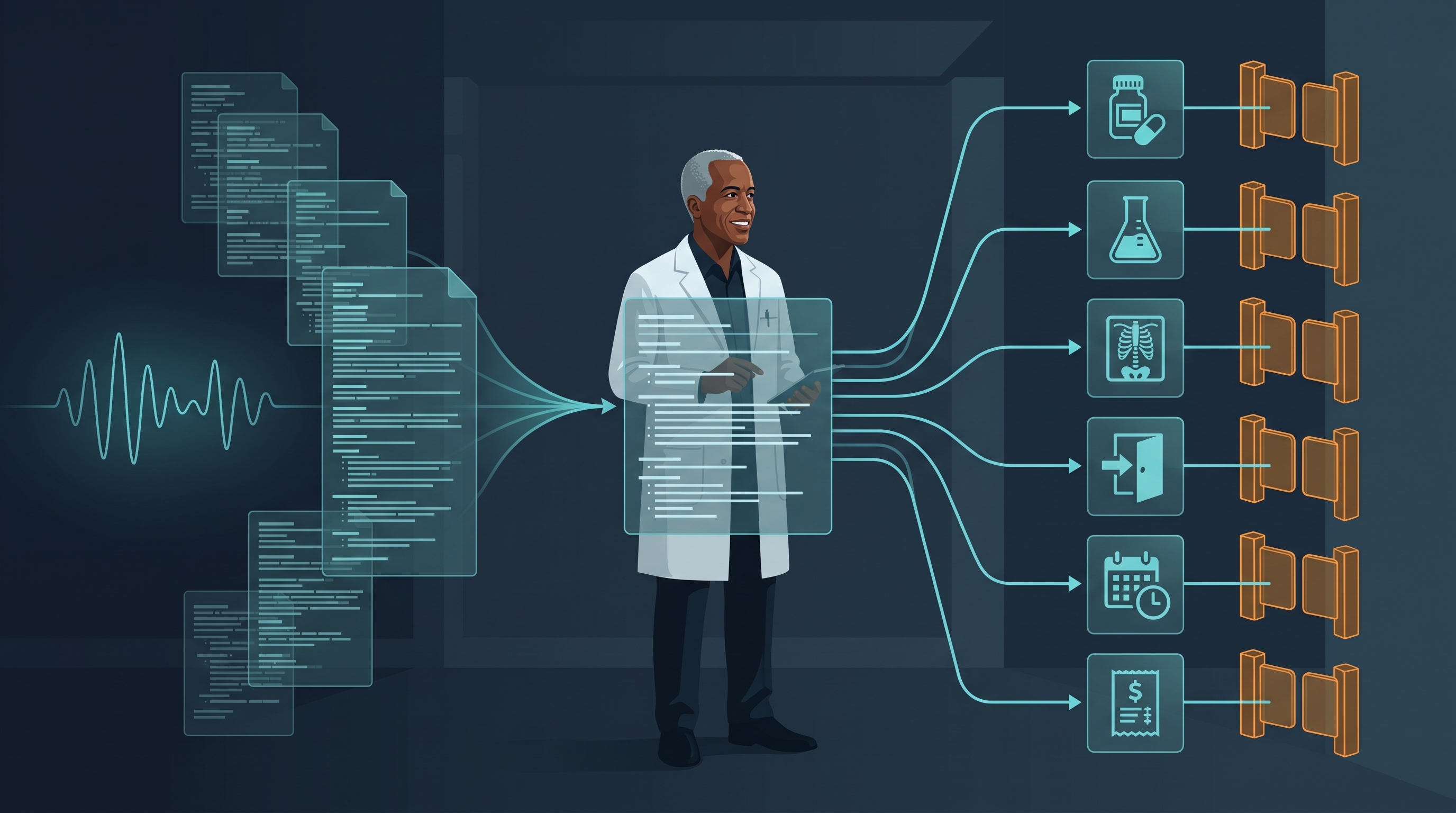
The Ambient Scribe Is Disappearing
Ambient clinical AI is moving beyond note generation into an encounter layer that prepares orders, prescriptions, coding, and follow-up while keeping consequential decisions visible to the physician.
Maternal-Fetal Medicine Specialist