AI Scribes Are Failing Doctors—Here's the Brutal Truth the NEJM Won't Say Out Loud
By Dr. Chukwuma Onyeije, MFM Specialist & Founder of CodeCraftMD
Listen to this post
AI Scribes Are Failing Doctors—Here's the Brutal Truth the NEJM Won't Say Out Loud

“Why Your AI Scribe Isn’t Saving You Time (And What Will)”
By Dr. Chukwuma Onyeije, MFM Specialist & Founder of CodeCraftMD
Reading time: 8 minutes
Every healthcare tech vendor promises the same thing: “Our AI will give you back hours of your day.”
But after two major randomized controlled trials and millions in implementation costs, here’s what we actually got:
7-12 minutes saved per clinical session.
Not per patient. Per session.
That’s barely enough time to grab coffee.
The Promise vs. The Reality
Ambient AI scribes entered healthcare with transformational promises:
-
Cut documentation time in half
-
End physician burnout
-
Give doctors their lives back
-
Increase clinical productivity
A new NEJM AI editorial analyzing landmark trials from University of Wisconsin and UCLA reveals something healthcare executives don’t want to admit:
AI scribes reduce burnout. They improve patient satisfaction. But they do NOT meaningfully increase productivity.
And if you understand clinical workflow—not just documentation—you already know why.
What the Evidence Actually Shows (And Why It Matters)
Two major RCTs tested three leading platforms: Abridge, Microsoft DAX Copilot, and Nabla.
Study #1: The Best-Case Scenario (University of Wisconsin)
Context: Ideal implementation with institutional support
Results:
-
71% physician adoption
-
Nearly 100% patient consent
-
~22 minutes saved per day
-
Significant burnout reduction
The catch? This required optimal conditions rarely seen in real clinical settings.
Study #2: The Reality Check (UCLA)
Context: Typical clinical deployment
Results:
-
Only 29-33% physician adoption
-
7-12 minutes saved per 18-patient session
-
Control group also improved (suggesting external factors)
Translation: In real-world conditions, AI scribes save less than one minute per patient visit.
The Documentation Trap: Why Current AI Scribes Can’t Scale Impact
Here’s the problem healthcare tech companies won’t tell you:
Documentation is only 20% of your administrative burden.
The real productivity killers are:
The Invisible Clinical Workload:
-
Medical order entry: 15-20 minutes per patient
-
Prior authorization requests: 20-30 minutes per case
-
Lab and imaging review: 30-45 minutes daily
-
Medical coding and billing: 10-15 minutes per encounter
-
Patient message responses: 45-60 minutes daily
-
Clinical loop closure: 20-30 minutes daily
Current AI scribes handle the note. They ignore everything else.
That’s like automating the title page of your dissertation and calling it “productivity software.”
Why Physicians Aren’t Seeing Productivity Gains
The NEJM editorial identifies the core issue:
“True productivity gains will occur only when AI automates downstream tasks triggered by clinical documentation, not just the documentation itself.”
Translation: We need workflow automation, not just documentation automation.
Think about your last clinic day:
-
AI scribe captures the visit ✅
-
You manually enter orders ❌
-
You manually code the encounter ❌
-
You manually draft the prior auth ❌
-
You manually respond to follow-up messages ❌
-
You manually close clinical loops ❌
One step automated. Five steps still manual.
That’s why you’re still charting at 10 PM.
The Next Evolution: Context-Aware Clinical Workflow Automation
Here’s what second-generation clinical AI must do:
From Documentation to Action:
Current State (AI Scribe):
-
Captures clinical conversation
-
Generates progress note
-
Stops there
Next Generation (Workflow AI):
-
Captures clinical conversation
-
Generates progress note
-
Auto-drafts medical orders based on clinical plan
-
Suggests accurate ICD-10 and CPT codes with documentation support
-
Pre-populates prior authorization language
-
Creates billing summaries
-
Generates structured data for EHR import
-
Triggers appropriate clinical follow-ups
The technology already exists. AI scribes already capture the full clinical context.
The problem? Nobody’s building the integration layer.
Why Physician-Developers Will Win This Space
Healthcare tech companies optimize for:
-
EHR vendor relationships
-
Hospital procurement cycles
-
Enterprise sales targets
Physician-developers optimize for:
-
Actual clinical workflow
-
Real documentation requirements
-
Regulatory compliance reality
-
What actually saves time
This is why Doctors Who Code exists.
And it’s why I built CodeCraftMD.
CodeCraftMD: Building the Workflow Layer Healthcare Needs
As an MFM specialist who codes, I see the gap every single day.
AI scribes give us the note. They don’t give us:
-
The billing codes
-
The authorization language
-
The order sets
-
The structured data
-
The workflow integration
CodeCraftMD is building exactly that missing layer:
Our Core Capabilities:
-
Clinical note → accurate ICD-10/CPT codes with explanation
-
Auto-generated billing summaries
-
Prior authorization language extraction
-
Structured documentation for EHR import
-
Compliance-ready audit trails
-
API-first architecture for workflow integration
Our Vision:
If AI scribes are the “note,” CodeCraftMD is the “workflow.”
We’re transforming documentation automation into complete clinical workflow automation—the exact evolution the NEJM AI editorial argues must happen.
The Uncomfortable Truth About Healthcare AI
Current AI scribes are expensive bandaids:
-
Cost: $150-400 per physician per month
-
Time saved: 7-22 minutes per day
-
ROI: Unclear at scale
-
Adoption: 29-71% physician uptake
-
Productivity impact: Minimal to none
They improve burnout metrics. They increase patient satisfaction scores.
But they don’t solve the productivity crisis.
And as physician shortages worsen, healthcare systems can’t afford incremental solutions.
We need transformational ones.
What This Means for You
If you’re a clinician:
-
Don’t expect current AI scribes to give you your evenings back
-
Understand what they can do: reduce documentation burden and emotional exhaustion
-
Demand workflow automation, not just documentation automation
If you’re a physician-developer:
-
The clinical workflow automation space is wide open
-
Enterprise healthcare tech companies are moving too slowly
-
Physician-led solutions will define the next decade
If you’re a healthcare administrator:
-
AI scribe ROI depends heavily on implementation quality
-
True productivity requires downstream task automation
-
Partner with physician-developers who understand clinical reality
The Future Is Being Built Right Now
Ambient AI scribes represent meaningful progress. They’re just not the finish line.
The next generation of clinical AI will:
-
Integrate deeply with EHR workflows
-
Automate downstream administrative tasks
-
Generate accurate billing documentation
-
Handle compliance requirements automatically
-
Free physicians to practice at the top of their license
At Doctors Who Code, we’re equipping physicians to build that future.
At CodeCraftMD, we’re building the tools to make it real.
Join the Movement
The future of clinical AI won’t be built by enterprise vendors optimizing for procurement cycles.
It will be built by physicians who code—who understand both clinical workflow and software development.
Follow along:
-
Subscribe to Doctors Who Code for physician-developer insights
-
Track CodeCraftMD development updates
-
Join the community of clinicians building the future of healthcare technology
Because the physicians who combine clinical expertise with technical skills won’t just use the next generation of healthcare AI.
They’ll build it.
About the Author:
Dr. Chukwuma Onyeije is a Maternal-Fetal Medicine specialist, Medical Director at Atlanta Perinatal Associates, and founder of CodeCraftMD. He bridges clinical medicine and software development through Doctors Who Code, empowering physicians to participate in building healthcare’s technological future.
Connect:
-
Twitter: CODECRAFTMD
-
LinkedIn: LinkedIn
-
Email: info@codecraftmd.com
References:
NEJM AI Editorial on Ambient AI Scribes and Physician Productivity (2025)
Shanafelt TD, et al. Physician Burnout Rates and Contributing Factors
Afshar M, et al. University of Wisconsin AI Scribe RCT
Lukac M, et al. UCLA AI Scribe Implementation Study
Frequently Asked Questions
How much time do AI medical scribes actually save?
Two major RCTs showed 7-12 minutes saved per clinical session in real-world conditions (UCLA, 29-33% adoption). Best-case results under optimal implementation (University of Wisconsin) reached approximately 22 minutes per day. Both studies confirmed burnout reduction and improved patient satisfaction — but neither showed meaningful productivity gains.
Why are physicians still charting at 10 PM even with AI scribes?
Because AI scribes only automate one step in a multi-step administrative workflow: the progress note. After the note is written, physicians still manually enter orders, code the encounter, draft prior authorizations, respond to patient messages, and close clinical loops. One step automated out of six is not a productivity solution.
What is the difference between documentation automation and workflow automation?
Documentation automation — what current AI scribes provide — captures the clinical visit and generates a note. Workflow automation extends downstream: auto-drafting orders based on the clinical plan, generating accurate billing codes, pre-populating prior authorization language, creating billing summaries, and triggering appropriate follow-ups. The NEJM editorial concluded that true productivity gains require automating downstream tasks, not just the note.
Which AI scribe platforms were studied in the 2025 NEJM research?
The NEJM AI editorial analyzed RCTs covering three platforms: Abridge, Microsoft DAX Copilot, and Nabla. Physician adoption rates ranged from 29-71% depending on implementation quality, institutional support, and deployment context.
What is CodeCraftMD and how does it address the workflow automation gap?
CodeCraftMD is a clinical workflow automation platform built to handle the downstream tasks that AI scribes leave behind: accurate ICD-10 and CPT code generation, prior authorization language extraction, billing summaries, and structured documentation for EHR import. Where AI scribes generate the note, CodeCraftMD automates the administrative translation that follows it. It was built by an MFM specialist who experiences this gap daily.
Related Reading:
Keywords: AI medical scribes, physician burnout, clinical documentation, ambient AI, DAX Copilot, medical coding automation, physician productivity, EHR automation
Related articles
The Future of Clinical Documentation: A Practical AI Tech Stack for Physicians Who Code
> Keywords: AI clinical documentation, ambient transcription, EvidenceMD, CodeCraftMD, physician automation, clinical workflow, medical billing automati...
The Ambient Scribe Is Disappearing
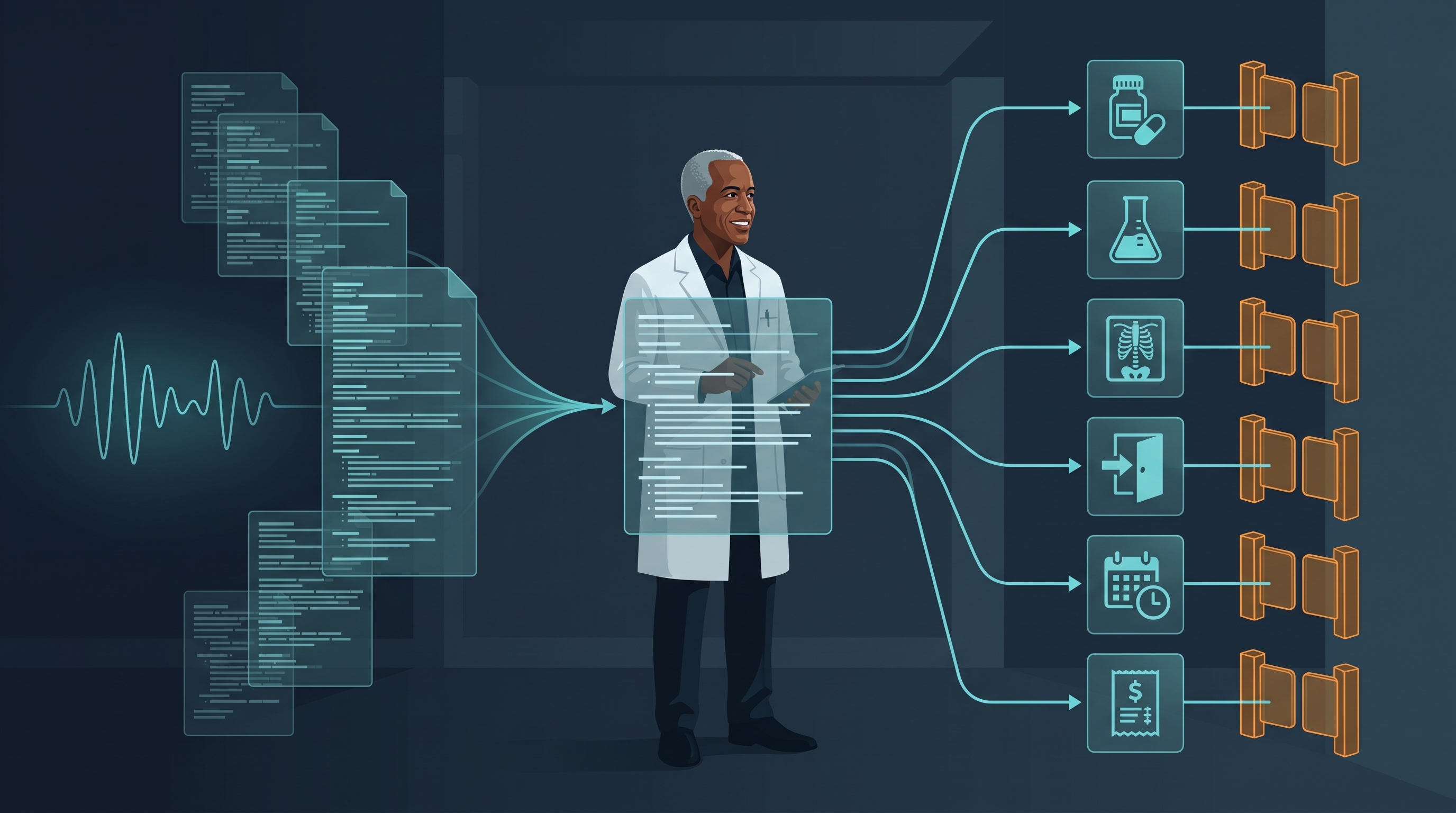
Ambient clinical AI is moving beyond note generation into an encounter layer that prepares orders, prescriptions, coding, and follow-up while keeping consequential decisions visible to the physician.

I Gave an AI Agent 94 Skills and Let It Help Run My Clinical, Coding, and Theology Workflows
Three weeks into running Hermes Agent in production, I can say this: the real value is not the model. It is the workflow ecosystem wrapped around it. Here is what 94 specialized skills looks like in a real physician-developer stack.
Maternal-Fetal Medicine Specialist