Building the Physician's Knowledge Flywheel
Why the vault gets exponentially more valuable the more you use it. The long-game thesis: this is the clinical infrastructure that vendors cannot build.
Listen to this post
Building the Physician's Knowledge Flywheel
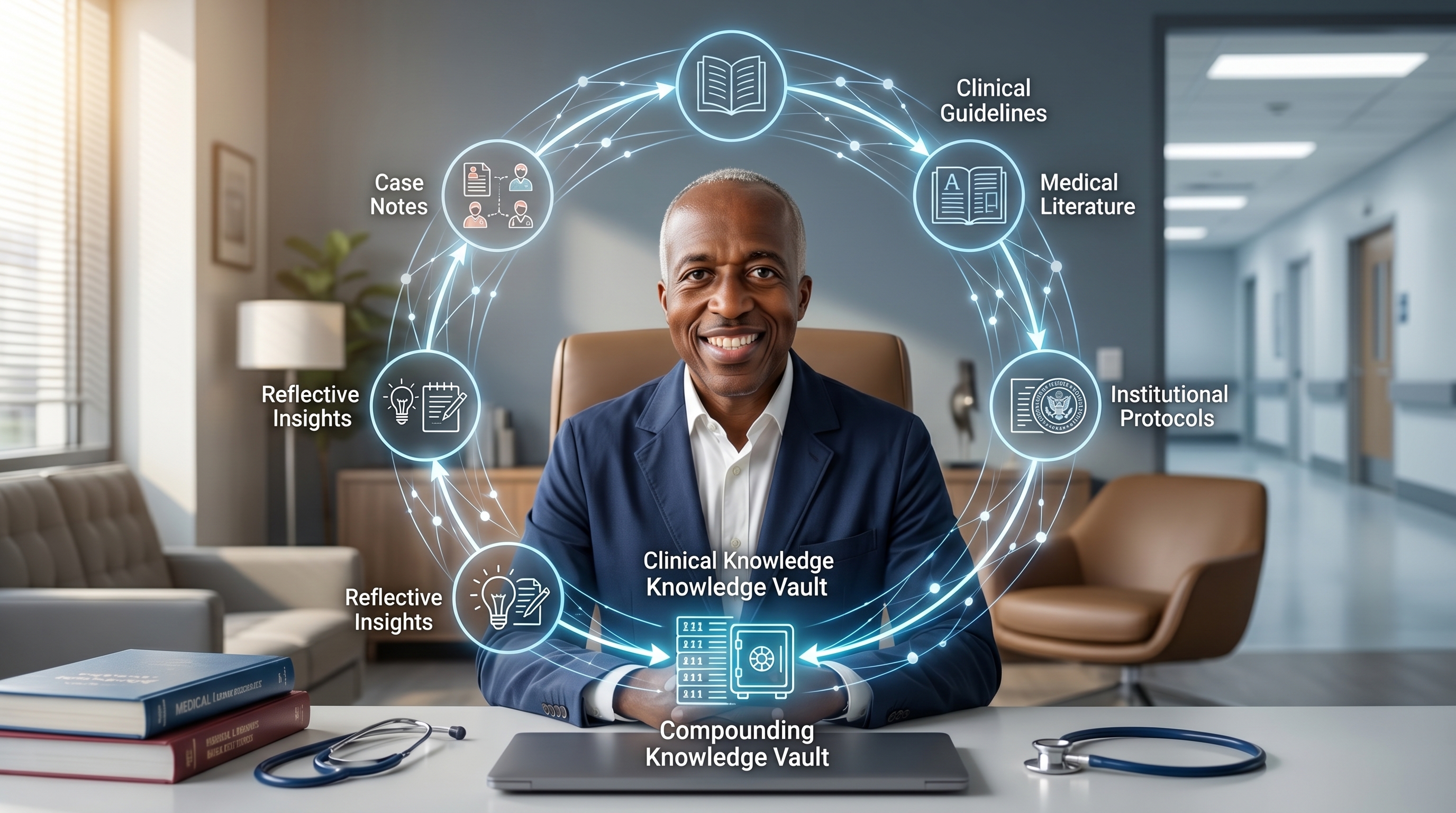
On this page11 sections
If you have read the prior four posts, you understand the system.
You know why existing PKM failed. You know how Karpathy’s compilation approach differs from RAG. You know the technical stack. You know the thinking-partner commands.
But none of that matters if you do not understand the flywheel. The thing that makes your vault exponentially more valuable the longer you maintain it.
Unlike every other knowledge system a physician has used, this one compounds.
What Textbooks Cannot Do
UpToDate is static. It synthesizes expert knowledge once and updates it when the guidelines shift. That is genuinely useful. It is also ceiling-limited.
UpToDate does not learn how you practice. It does not adapt to your institution. It does not capture your hard-won clinical judgment. It does not grow from your cases. It serves you the same synthesis it serves everyone else.
A textbook is the same.
Your vault serves you something no textbook can: synthesis that reflects your practice.
After six months of ingests, your vault does not contain generic knowledge. It contains knowledge about:
- How AEDV at 28 weeks presents in your patient population
- How your institution’s specific neonatal capabilities affect delivery timing decisions
- Which interventions actually change outcomes in your practice setting
- Where your clinical outcomes diverge from published literature and why
- The specific failure modes you have learned to anticipate
- The biases in your own reasoning
A textbook cannot contain this. A vendor AI system cannot contain this. Only you can build this.
The Six-Month Inflection
Three months in, the vault is useful. You have ingested SMFM guidelines, key literature on your specialty, your institutional protocols. Queries return better answers than Google. You use the thinking-partner commands regularly.
It is good. It is not yet transformative.
Six months in, something shifts.
You have now managed dozens of complex cases and fed your reasoning back into the vault. The lint operations have flagged contradictions. You have reviewed and resolved them. The vault now contains not just published guidance but your synthesis of that guidance through the lens of your practice.
You run /challenge on a complex case and the vault does not just pressure-test your general reasoning. It surfaces three cases from your own history where you faced similar decision points. It reminds you of the specific outcome in each one. It flags where your current reasoning deviates from your own patterns.
This is diagnostic support that cannot exist outside your vault.
Pattern Recognition at Scale
A year in, something stranger happens. The vault surfaces patterns you never consciously noticed.
You ask: “What is my gestational diabetes screening interval in multiple pregnancy?”
The vault does not just retrieve the ACOG guideline. It retrieves your cases. It has processed 80 second-trimester ultrasounds where you managed multiple gestation. It has noted that in seven cases, you modified the surveillance interval based on fundal height trajectory. In three of those, the patient developed preeclampsia earlier than expected.
The vault surfaces: “In your practice, maternal height under 62 inches in multiple gestation has preceded preeclampsia by an average of 8 days. This may warrant earlier intensive monitoring.”
This is not a pattern published anywhere. This is a pattern in your practice. You never articulated it consciously. But the vault extracted it from your case notes because you fed it case after case after case.
That is the flywheel. Every case you ingest teaches the system something about your practice. Every query benefits from the accumulated learning.
Why This Applies Beyond Clinical Practice
The second-brain thesis is not limited to clinical medicine. It applies to every domain where:
- You accumulate domain-specific knowledge over time
- That knowledge compounds on itself
- The stakes are high enough to warrant precision
It applies to performance data (PGIS, my metabolic health project, accumulates continuous glucose monitoring and heart rate variability patterns, and the vault grows smarter about your metabolic phenotype).
It applies to training logs (for endurance athletes like myself, the vault becomes a coach that knows how your body responds to specific stimulus patterns, not generic training zones).
It applies to any domain where the synthesis matters more than the raw data.
Why Vendors Cannot Build This
This is the critical point. The institutional AI companies cannot build this for you.
Here is why: the knowledge that matters most for your clinical practice is domain-specific, context-specific, and practice-specific.
Vendors optimize for breadth. A vendor’s AI system serves emergency medicine residents alongside maternal-fetal medicine specialists alongside urologists. The vendor cannot encode the domain knowledge that makes your practice different because doing so would require knowing your practice better than you know it.
You are the domain expert.
What you can do — what only you can do — is build infrastructure that learns your practice. That ingests your cases, your protocols, your outcomes data, your clinical reasoning.
That is the unfair advantage. That is why the physician-developer who builds this system has something a purchased AI system cannot replicate.
The model is not the advantage. Your vault is.
The Physician-Developer Infrastructure Thesis
This is a broader argument. There is an entire class of clinical infrastructure problems that vendors cannot solve because they require domain knowledge that only exists in the physician community.
Consider what needs to be built:
- Systems that learn institutional protocols instead of implementing generic ones
- Clinical decision support that reflects your evidence interpretation, not consensus
- Real-time patient monitoring that understands your specific risk tolerances
- Quality improvement systems that know your outcomes in granular detail
- Training tools that adapt to your learning patterns
These cannot be purchased. They can only be built by physicians who understand the domain deeply enough to make the right architectural tradeoffs.
That understanding is not marketable. It is not licensable. It is not vendorable.
So the vendors have largely ignored these problems. Which means they are open for the physician-builders to solve.
The Flywheel at Scale
After a year, your vault is not just a better search engine. It is a thinking partner.
After two years, it is infrastructure. You have built something that has no external equivalent. You cannot replace it with a purchased system because no purchased system knows your practice, your cases, your institutional context, your outcomes.
After three years, it becomes generative. New residents or physicians joining your practice do not start from zero. They inherit your vault. They inherit the accumulated synthesis of thousands of cases. They inherit your clinical judgment, encoded in entity pages and decision trees.
That is when the real leverage begins.
The Case for Why This Matters Now
This was not possible five years ago. LLMs were not capable enough. The local compute was not available. The tooling did not exist.
It is possible now.
And the physicians who build these systems in 2026 will have an unfair advantage over those who do not.
Not because they are smarter. Not because they code better. But because they have chosen to build infrastructure that compounds their own knowledge.
The Meta Layer
There is one more layer to this.
The physicians building these systems are not hobbyists. They are not playing with technology for the sake of playing. They are building the infrastructure layer that clinical AI will eventually need to run on.
The models (GPT, Claude, Llama) are commoditizing. Twenty vendors will have capable foundation models by 2027.
But the domain-specific knowledge layers? The institutional vaults? The practice-specific synthesis systems?
Those cannot commoditize. Those require the person who has lived in the domain.
So the physician who builds a vault, in 2026, is not just improving their own practice. They are building the infrastructure layer that the next generation of clinical AI will run on.
The question is: will that infrastructure belong to you, or will you be licensing it from a vendor for the next twenty years.
Key Takeaways
- Your vault compounds over time in ways textbooks and purchased systems cannot
- After six months, the vault contains synthesis specific to your practice
- After a year, it surfaces patterns in your own clinical reasoning you never consciously noticed
- Vendors cannot build this because it requires domain expertise only you have
- The real leverage comes from infrastructure, not from models
- Physicians who build these systems now are building the infrastructure layer clinical AI will need to run on
- The model is commodity. Your vault is not.
- This is why the physician-builder thesis matters now.
Series Navigation
← Post 4: The Thinking Partner Commands | Back to Series Overview
Related articles
What Karpathy Actually Built (and Why It Matters for Medicine)
The compilation analogy, explained for clinicians. How LLM Wiki compiles clinical knowledge into synthesized entity pages instead of re-retrieving chunks on every query.

The PKM System That Was Never Built for You
Why every personal knowledge management app failed physicians specifically, and why Karpathy's April 2026 LLM Wiki changes everything.

The Physician's Second Brain: A 5-Post Series
A complete guide to building an LLM-powered clinical knowledge vault. Why existing PKM failed physicians, how to build one that works, and why this is the infrastructure layer physicians must own.
Maternal-Fetal Medicine Specialist