I Had a Clinical Presumption. I Built Tools to Examine It.
A question about glucose monitoring became an evidence review, two presentations, and a lesson in why clinical responsibility includes the interface.
Listen to this post
I Had a Clinical Presumption. I Built Tools to Examine It.
On this page6 sections
I began reviewing continuous glucose monitoring in gestational diabetes with a clinical presumption: seeing more of a patient’s glucose patterns should help us make better decisions. The reasoning was plausible. The evidence needed to establish where it held, which outcomes improved, and what remained unresolved.
That question became an evidence review, two educational presentations, and printable tools for patients and clinicians. As I built them, I had to make the boundaries of the evidence as usable as the findings themselves.
The work changed both the claim I could defend and what I considered a finished clinical literature review.
I. The presumption needed separate questions
I suspected that continuous glucose monitoring represented an emerging shift in how we understand glucose exposure during pregnancy.
Continuous glucose monitoring, or CGM, measures glucose in fluid under the skin. Self-monitoring of blood glucose, or SMBG, uses a meter and a small blood sample obtained by finger stick. A sensor can reveal patterns between scheduled checks: overnight changes, the duration of excursions, and the direction glucose is moving.
The additional information seemed valuable. I needed to examine what that value established.
Does the device measure reliably? Does the additional information help guide care? Does acting on it improve pregnancy outcomes? Which findings should trigger treatment?
Those questions require different evidence.
| Question | Evidence needed |
|---|---|
| Does the sensor measure reliably? | Device-validation studies, including performance when readings disagree. |
| Does the monitoring strategy improve care? | Trials that examine outcomes within a defined care pathway. |
| Which patterns should change treatment? | Evidence supporting actionable targets in the population being treated. |
A device-validation study does not establish a neonatal benefit. An association between a glucose metric and an outcome does not establish that treating to that metric improves the outcome.
Measurement, clinical utility, and treatment targets are separate claims.
That distinction gave the review its structure. It also gave me a way to challenge my starting assumption without discarding the value of continuous data.
II. The research narrowed the claim
I examined sensor accuracy, discordant readings, patient burden, access, and the evidence supporting changes in management.
The randomized trials did not produce a uniform answer.
GRACE found fewer large-for-gestational-age births with CGM. Its authors also identified a higher-than-expected overall prevalence of small-for-gestational-age infants that warranted further investigation.
DipGluMo found no significant improvement in its composite perinatal endpoint. Steady Sugar reported favorable secondary outcomes despite a nonsignificant primary time-in-range result. Valent and colleagues demonstrated improved glucose time in range; that result did not, by itself, establish a definitive neonatal benefit.
Even the glucose ranges used to calculate time in range differed between studies. The label alone was insufficient. I had to examine what each trial actually measured.
The populations also mattered. Gestational diabetes, preexisting type 1 diabetes, and preexisting type 2 diabetes cannot be treated as interchangeable evidence categories. The ADA’s 2026 pregnancy guidance distinguishes established CGM percentage goals for type 1 diabetes in pregnancy from percentage targets that remain undefined for gestational and type 2 diabetes.
My presumption survived in a narrower form:
CGM expands what we can see. Research must establish how best to act on that information.
That conclusion leaves room for individualized monitoring decisions, including finger-stick monitoring as a reasonable plan. It also keeps a promising technology from carrying claims the evidence has not earned.
III. Two audiences required two designs
A patient choosing a monitoring approach has different questions from a physician appraising a trial.
The patient needs to understand what each method involves. Why can readings differ? When might a meter check be needed? Who reviews the data? What will the supplies cost?
The clinician needs primary endpoints, denominators, comparator care, confidence intervals, funding, and limits of extrapolation.
I built two resources around those decisions.
The patient presentation contains 12 slides. It explains the monitoring methods in plain language and includes questions for the care team. Its two-page discussion guide provides space for an individualized monitoring and contact plan.
The clinician presentation contains 23 slides. It compares the major trials, separates population-specific guidance, and uses illustrative cases to examine interpretation. Its two-page evidence brief makes the central findings available in a compact format.
Both presentations include references and downloadable full-deck PDFs.
The patient resource supports a conversation. The clinician resource supports appraisal. The evidence remains consistent; the organization follows the reader’s decision.
That is a development requirement. Audience determines what belongs on the screen, what needs explanation, and what must remain available for closer inspection.
IV. The human checkpoint includes the interface
I used AI-assisted development to organize the material, produce the HTML, and prepare the printable documents. I still had to decide what the evidence supported and how the resources should communicate it.
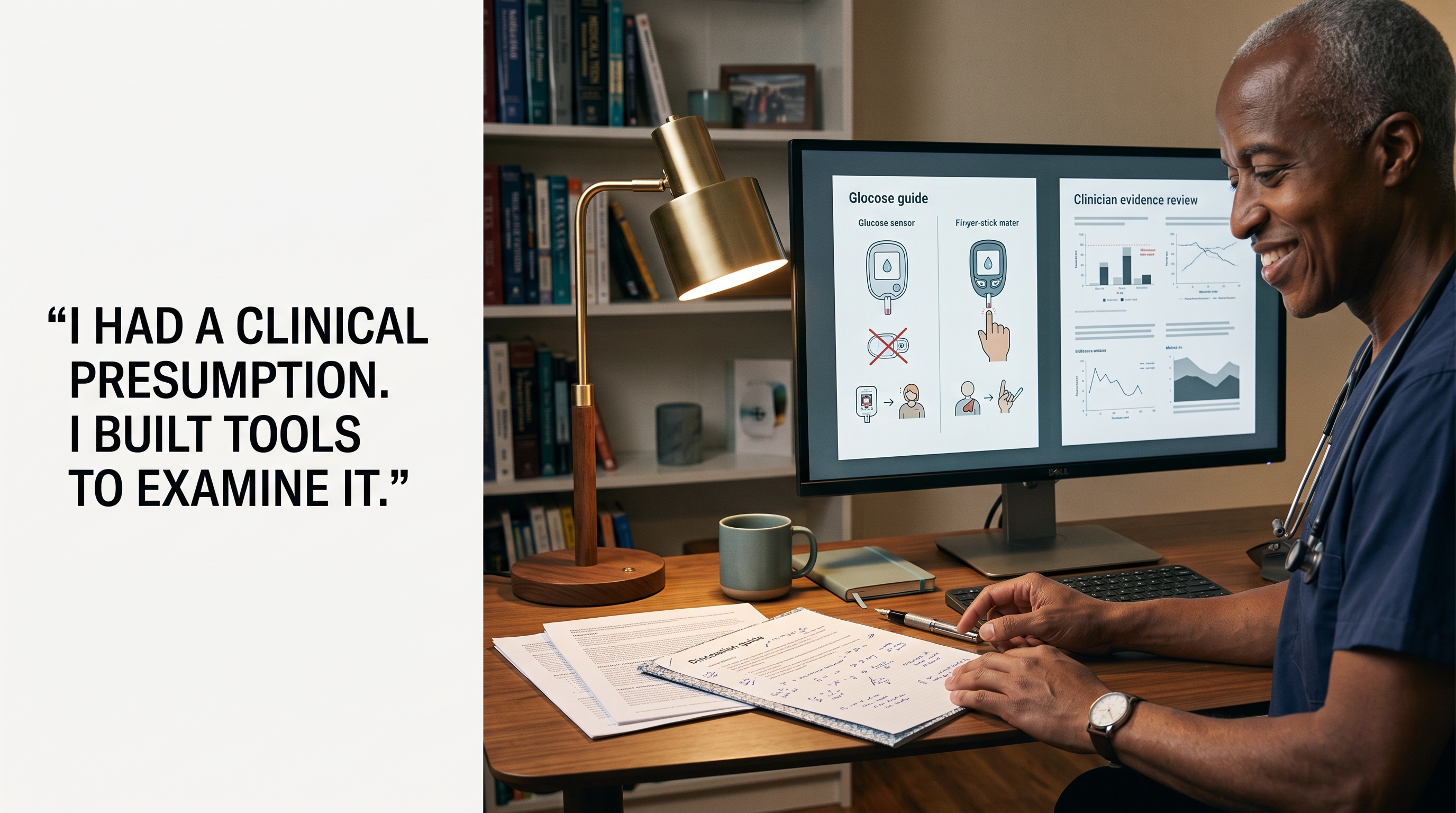
On slide 3 of the patient presentation, the sensor and meter illustrations were paired with the wrong explanations. I caught the reversal during review. We corrected the pairings, checked that they held when the columns stacked on a phone, and updated the PDF.
A review of the text alone would have missed the error. Each definition was correct. The association between the picture and the explanation was wrong.
The human checkpoint must examine the complete artifact: language, image placement, reading order, mobile layout, and printed output. A reader encounters those elements together.
The same obligation applies to evidence displays. A favorable secondary outcome placed more prominently than a null primary outcome can distort interpretation without changing a number. A population label that disappears into a footnote can invite an unsupported extrapolation.
The interface participates in the clinical argument.
That makes rendered review part of evidence review. The question is both whether the content is accurate and whether its presentation preserves its meaning.
V. Research needs a distribution plan
A careful literature review can remain on one person’s computer. The reasoning exists, but the patient and the next clinician cannot use it.
This is the distribution problem in concrete form: how does an examined clinical question become something another person can use?
For this project, HTML made the material available in a browser, supported navigation, and placed references near the claims they supported. PDF companions served printing, sharing, and use away from the presentation.
The files went into the OpenMFM repository and through a production deployment. Browser checks covered navigation and mobile layouts. Print review checked page counts, legibility, and clipping.
Those steps belong to the same workflow as the literature review. A reference needs to be reachable. A patient explanation needs to remain readable on a phone. A printed guide needs enough space to record a plan.
Semantic HTML, version control, responsive layouts, and PDF inspection have direct consequences for how clinical knowledge reaches its audience.
The maintenance obligation follows publication. A resource can outlive the evidence that supported it. A dated review makes its age visible. A maintained repository makes correction possible.
VI. A workflow physicians who code should understand
This project gave one clinical question several usable forms. The clinician can inspect the evidence. The patient can understand the choice. Both can return to the sources.
The workflow is learnable:
- State the presumption. Make it precise enough to challenge.
- Test it against the literature. Look for evidence that supports and contradicts it.
- Separate the claims. Distinguish measurement performance, clinical outcomes, and treatment recommendations.
- Design for the decision. Organize each resource around what its audience needs to understand or do.
- Inspect the rendered artifact. Review the clinical content, visual associations, mobile behavior, and printed output.
- Publish for correction. Include references, revision dates, and a way to maintain the material.
My original presumption became a more precise argument. Building the resources gave that argument a usable form.
We are responsible for the interpretation we publish, including the interface through which someone else learns it.
Related articles

Maternal-Fetal Medicine Specialist