Fluent Answers Are Not Clinical Judgment
Language models can make uncertain medical information sound finished. The problem is not fluency. The problem is mistaking fluency for accountable clinical reasoning.
Listen to this post
Fluent Answers Are Not Clinical Judgment

On this page7 sections
The answer looked clean.
That was the first warning.
A language model can give a clean answer to a messy clinical question.
That is the problem.
Medicine is full of questions that look simple only after someone has removed the patient.
The patient has a history that does not fit the guideline neatly. The lab value is real, but the pretest probability is low. The ultrasound finding is subtle. The medication is reasonable in the abstract but wrong for this person because of a detail buried three paragraphs back in the chart.
Clinical judgment lives in those details.
Fluent language does not.
I. The Authority Gap
The problem with large language models in medicine is not that they produce language.
That is their strength.
The problem is that they produce language with a tone that can exceed the accountability of the underlying reasoning.
I call this the authority gap.
The authority gap is the distance between how confident an answer sounds and how accountable its reasoning actually is.
A traditional medical source has visible structure. A guideline has authors, dates, methods, evidence grades, conflicts of interest, and a sponsoring organization. A journal article has a study design, inclusion criteria, statistical methods, limitations, and citations. Even a textbook chapter has an editorial lineage.
A model output often arrives as a paragraph.
Clean. Organized. Helpful.
Sometimes correct.
Sometimes not.
The form is too smooth for the uncertainty underneath it.
That is the authority gap.
II. The Exam Problem
Drazen and Haug make an important point in their NEJM AI editorial. Language models can perform well on medical licensing examinations, but those examinations are built around questions with a single best answer.
Actual medicine rarely behaves that cleanly.
Board questions are designed to be solved.
Clinical care is endured by real people in real systems with incomplete information.
The board question tells you which facts matter.
The patient does not.
That difference is not cosmetic.
It is the difference between answer selection and clinical reasoning.
A model that performs well on exams may have encoded a large amount of biomedical knowledge. That matters. It is not trivial. It tells us these systems can map clinical language to plausible medical concepts.
But a licensing exam does not test whether the system knows when the question is underspecified.
It does not test whether the system can recognize that the best next step depends on a value preference the patient has not yet stated.
It does not test whether the system can explain which part of the answer comes from a guideline, which part comes from a trial population, and which part is inference.
Those are not side issues.
Those are the work.
III. Clinical Judgment Is Not a Sentence
Clinical judgment is often described as if it were an opinion.
It is not.
Clinical judgment is a disciplined act of integration. It joins patient data, disease biology, evidence, uncertainty, clinical experience, feasibility, and values into a decision that someone has to own.
That last part matters.
Someone has to own it.
The physician owns the decision in a way a model does not. Not because the physician is always right. Physicians are not always right. The physician owns the decision because the physician is accountable to the patient, the profession, the record, and the consequences.
That accountability changes how you think.
It makes you slow down when an answer is too clean. It makes you ask whether the patient in the trial resembles the patient in front of you. It makes you notice when the model has answered the general question but missed the clinical question.
The model can produce a recommendation.
It cannot carry the responsibility that makes a recommendation clinical.
IV. Where Fluency Misleads
There are several ways fluent answers mislead clinicians.
The first is compression.
A model compresses a large body of information into a small amount of language. Compression is useful. It is also lossy. The details that disappear may be the exact details that matter.
The second is smoothing.
Clinical evidence is jagged. Guidelines disagree. Trial populations are narrow. Recommendations change with gestational age, renal function, comorbidities, local resources, and patient goals. A fluent answer often smooths those edges into a paragraph that sounds more settled than the evidence is.
The third is source flattening.
A guideline, a review article, an expert opinion, and a model inference can appear in the same tone. Unless the system exposes provenance, the clinician may not know which layer is speaking.
The fourth is false completion.
The answer arrives, so the mind relaxes. The task feels done. That is dangerous when the most important part of the work is deciding whether the answer deserved to arrive in that form at all.
None of these failures require dramatic hallucination.
That is the uncomfortable part.
A model can be mostly right and still clinically unsafe if the rightness is not traceable, calibrated, and reviewable.
V. The Fluency Check
Physician-developers need a practical checkpoint.
I use the fluency check.
Before a model-generated clinical answer enters a workflow, ask four questions.
What is sourced? The answer should identify the evidence base. If it cannot show the source, it should not sound sourced.
What is inferred? The system should distinguish evidence-linked statements from probabilistic synthesis. A sentence that comes from a guideline and a sentence that comes from model reasoning are not the same thing.
What is missing? The system should identify required clinical facts that were absent from the prompt or record. Missing data should stop the workflow or downgrade the confidence.
Who owns the decision? The system should make the human checkpoint explicit. The physician must know where judgment is required before action is taken.
This is not a philosophical exercise.
It is a design requirement.
If a clinical AI system cannot pass the fluency check, it should not be trusted just because the language is good.
VI. What the Builder Owes the Clinician
The physician using a model at the bedside needs more than an answer.
She needs a reason to trust the answer.
Not emotionally.
Operationally.
She needs citations. She needs dates. She needs evidence hierarchy. She needs a clear statement of uncertainty. She needs to see which patient facts were used. She needs to know whether the system ignored a contraindication, failed to search current guidelines, or answered a nearby question instead of the actual one.
That means the builder has obligations.
Do not ship clinical fluency without provenance.
Do not collapse evidence and inference into the same tone.
Do not design interfaces that make acceptance easier than review.
Do not hide uncertainty because it makes the product feel less polished.
In clinical software, polish that conceals uncertainty is not polish.
It is risk.
VII. Keep the Judgment Where It Belongs
The answer is not to reject language models.
That would be too simple, and it would waste a powerful tool.
The answer is to put language models in the right role. They can retrieve. They can synthesize. They can draft. They can compare. They can surface relevant evidence faster than a physician can manually search across a growing medical corpus.
But they do not understand disease.
They do not understand fear in a consultation room.
They do not understand the difference between a statistically reasonable recommendation and a recommendation this patient can live with.
The physician-developer’s job is to build systems that respect that boundary.
Use the model for synthesis.
Use the physician for judgment.
Close the authority gap before the answer reaches the patient.
This is part two of the “Medicine as Information Infrastructure” series, following The Search Box Is Disappearing. The series responds to Drazen and Haug’s NEJM AI editorial, “Medicine as an Information Industry in the Age of Language Models” (DOI: 10.1056/AIe2600526).
Related articles

The Search Box Is Disappearing
Medicine is moving from retrieval to synthesis. That changes the physician's work from finding information to judging synthesized information under clinical pressure.

Medical Education Does Not Need an AI Course. It Needs a New Clinical Curriculum.
Preparing physicians for agentic AI requires more than an elective. Medical education must redesign how students reason independently, delegate work, verify machine output, and retain clinical judgment.
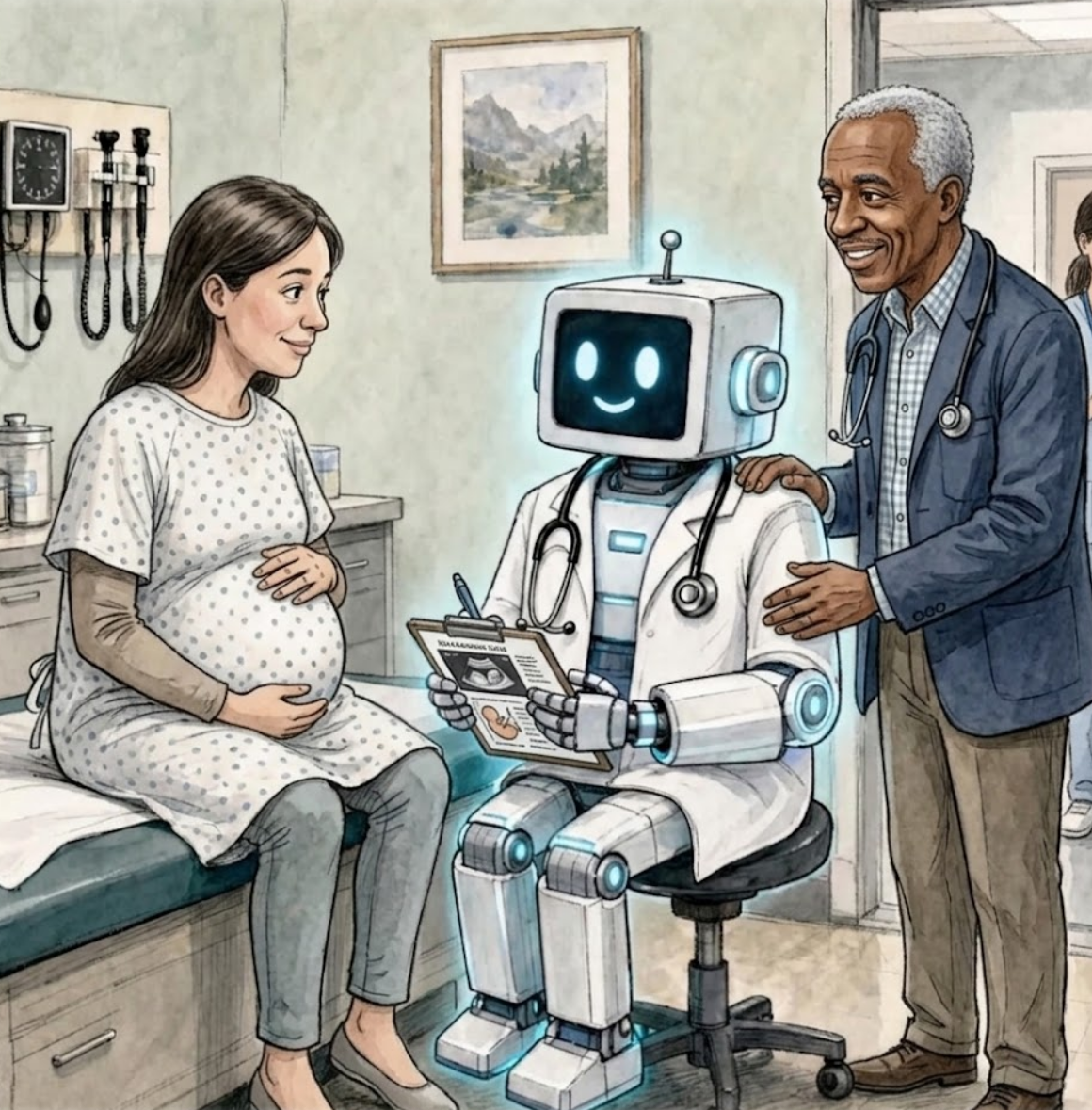
The Physician Above the Loop: Preparing Medicine for Agentic AI
Clinical intelligence is becoming abundant. Physicians must learn to delegate, verify, contextualize, and judge the work of increasingly autonomous clinical AI systems.

Maternal-Fetal Medicine Specialist