I Gave Doctors Who Code a Phone Number
DWC-Bot began as a voice assistant for Doctors Who Code. It is becoming an experiment in voice-first interfaces, second-brain capture, and physician-built agentic computing.
Listen to this post
I Gave Doctors Who Code a Phone Number

On this page 8 sections
DWC-Bot started as a simple experiment in voice. It is becoming something much more interesting: an interface between me, my ideas, my readers, and a new generation of agentic software.
I have spent a lot of time writing about artificial intelligence, clinical workflows, software architecture, and what happens when physicians stop accepting the technology they are given and start building the technology they need.
This week, I tried something slightly different.
I gave Doctors Who Code a phone number.
Not a phone number that rings my cell phone. A phone number that connects to an AI agent.
I call her DWC-Bot.
While she currently looks like a relatively small feature on DoctorsWhoCode.blog, I think she represents the beginning of a much larger experiment.

Meet DWC-Bot
My AI assistant for Doctors Who Code
Call DWC-Bot to ask about Doctors Who Code, find a learning path, explore my projects, or leave a speaking or collaboration inquiry. She can ask follow-up questions and summarize your request. You can also leave a message by text.
Calls connect with an AI assistant and are recorded and transcribed. Text messages are received, but automated text replies are not yet available.
For educational and professional inquiries. Please do not share patient information. This line does not provide medical advice or emergency assistance.
Meet DWC-Bot
DWC-Bot is a voice AI assistant designed around Doctors Who Code.
Visitors can call the bot and have a conversation about the site. They can ask about Doctors Who Code, explore active projects, find a structured learning path, or leave an inquiry about speaking, collaboration, or a topic they would like me to write about.
Crucially, the bot can ask follow-up questions rather than simply collecting a static voicemail.
That distinction matters.
Traditional websites are mostly repositories of information. You navigate menus, search pages, read articles, and hope to find what you need.
An agent turns that model around.
Instead of asking:
Where on this website is the information I need?
You can increasingly ask:
Can you help me figure out where I should start?
That is a fundamentally different interface. It turns a website from something you browse into something you can talk to.
A Voice Inbox for My Second Brain
One of the most interesting discoveries came almost immediately.
I realized that I did not only want other people to call DWC-Bot.
I wanted to call her too.
Ideas rarely arrive while I am sitting in front of an editor with a blank Markdown file open. They come while driving. While walking between clinics. Leaving the hospital. Thinking through a challenging case from earlier in the day. Or at 10:30 at night when I suddenly realize that two ideas I have been turning over for months are actually connected.
Historically, many of those thoughts disappear into the ether.
Now I can pick up the phone, dial DWC-Bot, and say something like:
“I have an idea for a Doctors Who Code article. We keep talking about ambient documentation as though transcription is the destination, but I think ambient systems are really becoming an operating system for clinical work…”
And then I just keep talking.
The conversation is recorded and transcribed. Later, I can return to that raw material in my Obsidian vault and turn it into a blog post, research question, software feature, presentation, or new project.
That makes DWC-Bot something else entirely: a voice inbox for my second brain.
Voice as the Low-Friction Interface for Agents
Most of our interaction with artificial intelligence still happens through a rectangle.
We sit at a computer. We open an application. We find a text box. We type.
That works well, but it is not how humans naturally capture rapid insights. Voice has a distinct property: extremely low friction.
Once that voice interface is connected to an agent, the phone number becomes much more than an answering service. It becomes an entry point into an active workflow.
For DWC-Bot, I see several roles emerging over time:
- Reader guide: Help someone find the right Doctors Who Code article, project, or learning path.
- Idea capture: Let me dictate thoughts on the go that feed directly into my writing and research pipeline.
- Collaboration intake: Collect structured context from physicians, researchers, and developers interested in collaborating.
- Content research: Identify questions readers repeatedly ask and use those insights to shape upcoming tutorials.
- Project interface: Allow spoken conversations to trigger structured backend workflows rather than merely producing transcripts.
- Agentic laboratory: Provide a real-world testing ground for voice agents, memory systems, tool calling, Model Context Protocol (MCP) servers, and human-agent interaction.
That last point is particularly important. I do not want to understand agents only by reading about them. I want to build them.
From Chatbot to Agent: The Real Product Is the Workflow
There is an important distinction between a chatbot and an agent.
A chatbot primarily answers questions. An agent can do something meaningful after the conversation ends.
Imagine telling DWC-Bot:
“I have an idea for an article about why doctors tolerate bad software.”
Today, the system records and transcribes that thought. But the eventual workflow will be much richer.
The agent will recognize that this is a content idea, create a structured note, add relevant tags, connect it with related notes in my vault, place it into my writing queue, draft a preliminary outline, and remind me of related pieces I wrote six months ago.
The conversation is only the interface. The real product is the workflow behind the conversation.
That is where agentic computing becomes transformative.
The Phone Number Is an API for Humans
I have started thinking about phone numbers differently because of this project.
A telephone number is one of the most universal interfaces humans have ever created. You do not need to download another application. You do not need an API key. You do not need to learn a command-line interface.
You already know what to do. You call.
For over a century, telephone numbers connected one human to another human. Today, a phone number can connect a human to software capable of listening, reasoning, clarifying questions, recording structured data, and executing tasks.
In that sense, a phone number is an API designed for human interaction.
Why I Am Building AgenticBuilderMD
DWC-Bot is not an isolated experiment. It is the first visible building block of another project I am launching: AgenticBuilderMD.
Doctors Who Code is about the journey from physician to builder: understanding software, optimizing workflows, learning to code, and creating clinical tools.
AgenticBuilderMD goes one level deeper.
I want to explore what happens when physicians begin building agents. Not simple prompts. Not another thin chatbot wrapper. Real agents that communicate through voice, interact with specialized tools, use structured clinical knowledge, maintain context, and operate safely across the boundaries between humans and software.
DWC-Bot is my first practical laboratory for that work.
The goal is not to create the world’s most complex voice agent on day one. The goal is to build something small enough that I understand every single layer.
Then improve it. Connect another tool. Add another workflow. Discover where it breaks.
That is how I learned to write code, and it is how physicians will learn agentic computing.
Build the Smallest Useful Agent
There is a temptation in AI to start with massive architecture diagrams: multiple agents, vector databases, complex orchestration, tool registries, memory layers, and autonomous loops.
There is nothing wrong with those concepts in the right context. But for physician-builders, I advocate a different approach: build the smallest agent that is genuinely useful.
My first version answers a phone call. That is useful.
It talks with visitors and answers questions about Doctors Who Code. Useful.
It records and transcribes ideas I would otherwise lose while driving. Very useful.
Now I have a working foundation to improve.
This has always been the core philosophy of Doctors Who Code. You do not have to become a computer scientist before you build something. You build something first, and the process of building it sharpens the questions you know how to ask.
A New Kind of Website
The fundamental interaction model of the web has remained unchanged for thirty years:
Homepage → Navigation → Page → Information
Agents introduce a different paradigm:
Intent → Conversation → Action
The website stops being merely a static destination. It becomes an interactive front door to an underlying set of capabilities.
That is the direction I am exploring with Doctors Who Code, DWC-Bot, and AgenticBuilderMD.
For now, the experiment begins with something simple and familiar: a phone number.
You call. She answers. And somewhere between that conversation and whatever comes next, we get a glimpse of where software is heading.
DWC-Bot is live on DoctorsWhoCode.blog at +1 (763) 878-7305. Call or text her with your questions, project ideas, or topics you want to see covered. I am building the rest in public.
Related articles

I Built an AI Agent. Now I Am Building the Laboratory Around It.
The Doctors Who Code phone bot led to AgenticBuilderMD: a public laboratory for learning agents, tools, memory, and human checkpoints through practical builds.
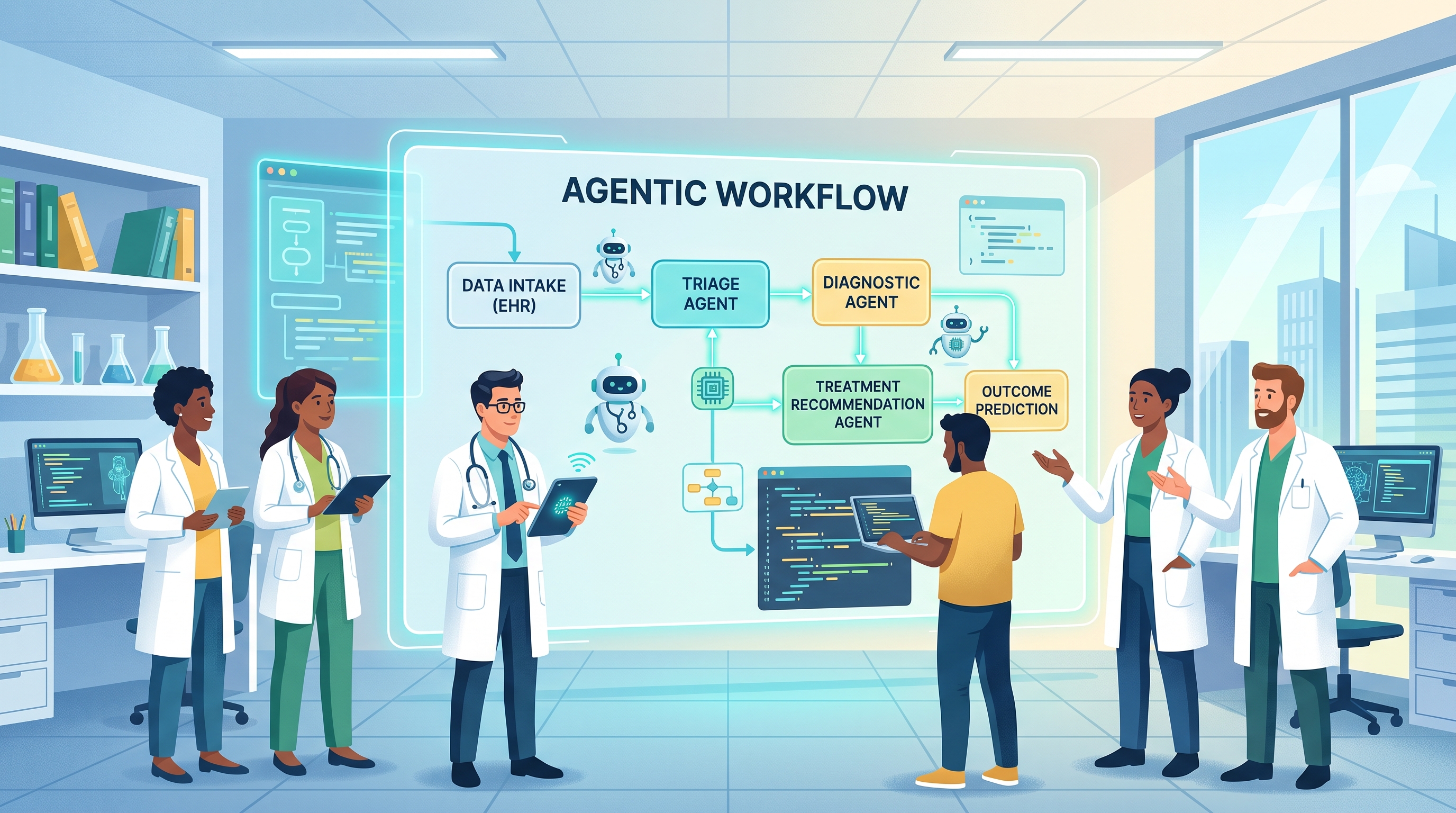
Your First Agentic Workflow: Delegate a Small, Verifiable Project
A physician-developer's practical guide to giving an AI agent one bounded software assignment and requiring a plan, tests, review evidence, and a stopping condition.

The Harness Is the Workplace: Choosing Where an AI Agent Works
Claude Code, Codex, Antigravity, OpenClaw, Hermes, and Omarchy illustrate a durable lesson for physicians: choose the agent's workplace before delegating the work.

Maternal-Fetal Medicine Specialist