Three GitHub Projects Physicians Can Actually Finish
Most physician-developer projects fail not because the ideas are bad but because the first build is too large. Here are three that are sized to finish.
Listen to this post
Three GitHub Projects Physicians Can Actually Finish
On this page9 sections
I have started and abandoned more projects than I have shipped.
The ones that died did not die because I lost interest in the problem. They died because I scoped them wrong from the start. A fetal echo DICOM classifier sounds like a logical first project for an MFM specialist interested in imaging AI. It is not. It is a six-month project disguised as a weekend idea.
The projects I actually finished were embarrassingly smaller than what I originally imagined. And they were worth more than the unfinished ones.
The lesson took me longer to learn than it should have.
Why Scope Kills Physician-Developer Projects
You have a finite window for a side project. A weekend here, a few evenings during a lighter week, maybe a dedicated stretch over vacation. That is real time. It is enough time. But only if the project fits inside it.
The failure mode is choosing a first build based on what would be most impactful at full scale. Full-scale clinical tools are worth building. They are not worth starting with. A first project that has no natural stopping point at the one-weekend mark will stall, accumulate guilt, and eventually get quietly abandoned.
Choose a project where version one ships. Everything else is version two.
Here are three project types that reliably fit that constraint.
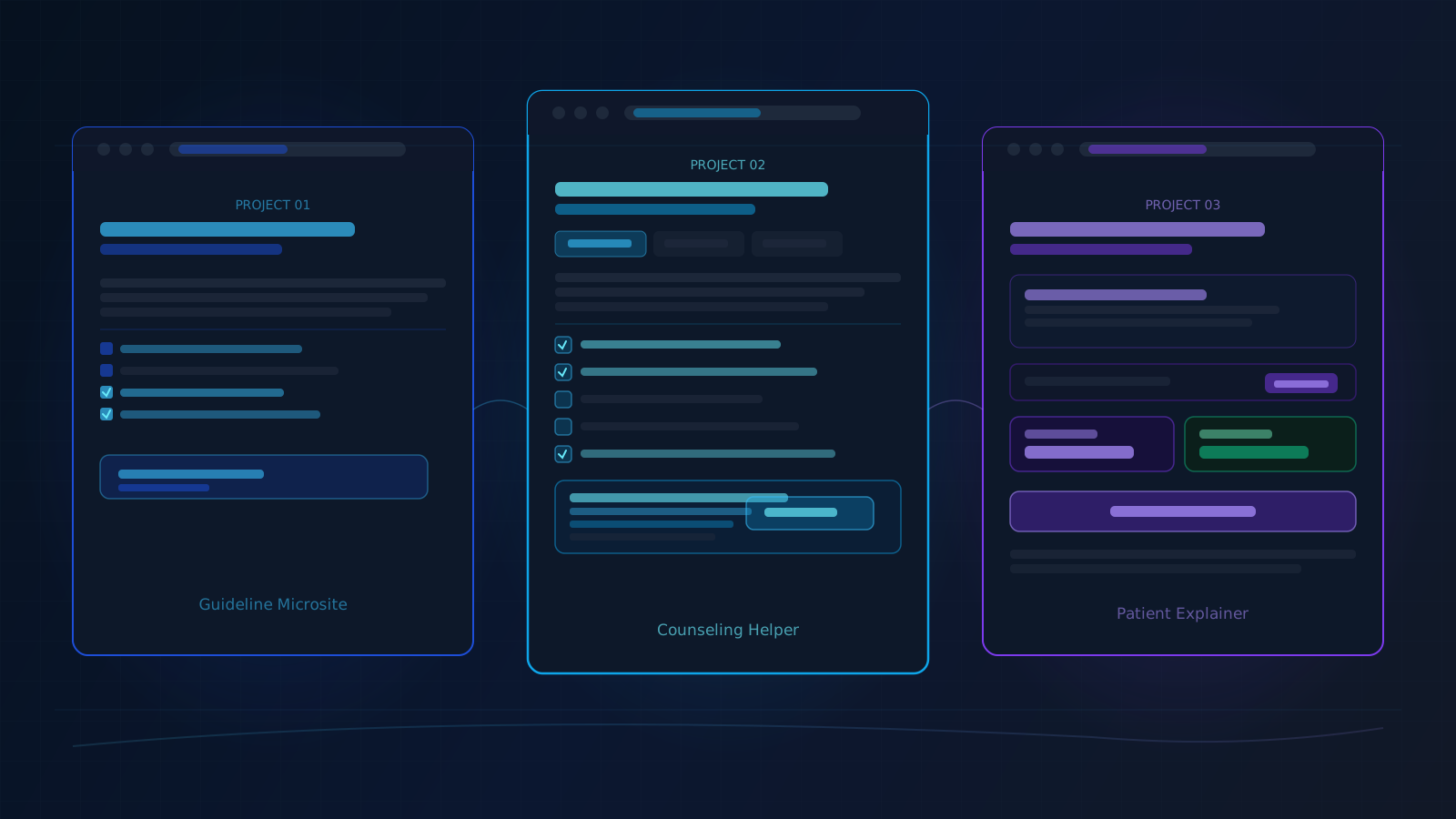
Project Type 1: A Guideline-to-Tool Microsite
Take a clinical protocol, decision pathway, or screening guideline you already use and turn it into a simple interactive page.
Specific examples:
- Aspirin screening eligibility in pregnancy (USPSTF / ACOG criteria)
- Postpartum blood pressure treatment thresholds and medication options
- Gestational diabetes follow-up visit schedule by treatment type
- Antenatal testing frequency by indication
- Cervical length screening criteria by obstetric history
Why this works as a first project:
You already understand the clinical logic. The domain knowledge problem is solved before you write a line of code. The scope is bounded by the guideline itself. And the clinical value is obvious, because the guideline already exists in some form that is harder to use than it should be.
The technical implementation is minimal. A single HTML page with some conditional logic, or a small React app if you want to practice components. The point is to make something static and authoritative become something interactive and fast to use in the moment of care.
That gap between “the guideline exists” and “the guideline is usable” is exactly where physician-builders can contribute something no vendor will prioritize.
Project Type 2: A Counseling Helper for One Repetitive Conversation
Not an AI scribe. Not an ambient documentation tool. A helper.
Pick one clinical conversation you have on repeat and build a small tool that standardizes and structures it.
Examples:
- Preeclampsia warning signs: when to call, when to go to triage
- VBAC decision-making: risks, benefits, candidate criteria
- Fetal growth restriction: what monitoring means, what parents should expect
- Insulin initiation: dose instructions, hypoglycemia recognition, adjustment rules
- IVF preconception checklist: labs, medications, timing
The tool does not need to generate text automatically. It can be a structured form that outputs a clean summary. Checkboxes the clinician completes before finishing the visit. A page with expandable sections covering each topic in patient-appropriate language.
This is not technically complex. It is clinically complex. That is your advantage. You know which questions patients always ask. You know which explanations cause confusion. You know what the counseling actually covers versus what the handout covers.
Build the tool you wish you had three years ago.
Project Type 3: A Patient-Facing Explainer with Decision Logic
This is the most underrated category.
Most physician-developers default to building clinician-facing tools. That makes sense. They know the clinical workflow.
But patient-facing tools with basic logic can be genuinely high-value, and they force a discipline that makes you a better builder: you cannot hide behind jargon, and you cannot assume the user knows what the output means.
Examples:
- Kick count tracker with threshold display and a clear call to action
- Postpartum blood pressure symptom checker (symptom inputs, when to call)
- Fetal movement FAQ by gestational age
- Preconception readiness checklist with explanations for each item
- Blood sugar log with gestational diabetes target range reminder
The scope constraint is built into the format. A patient-facing page has to be short, plain, and unambiguous. That forces every decision about what matters and what does not.
Building one of these will teach you more about user-centered design than most tutorials will.
What These Three Have in Common
Each of these project types shares the same properties:
The problem is one you understand from clinical experience. The first version can ship in a weekend. The clinical value is obvious without requiring external validation. The scope can be expanded in version two without needing a complete rebuild.
They also each teach the same foundational skills: scoping, documenting, version control, iterating from real feedback.
What to Avoid for a First Build
Building your own machine learning model. Integrating with an EHR. Creating a multi-role platform. Attempting diagnostic performance claims you cannot validate.
Those are real goals. They are not first-project goals.
The same applies to advanced topics like federated learning, privacy-preserving AI, and regulatory compliance pathways. Important to understand. Not the bottleneck in week one.
Your first project should have one job: demonstrate that you can take a clinical insight and ship it as working software.
A guideline-to-tool microsite does that. A counseling helper does that. A patient-facing explainer does that.
None of them require a neural network.
The Real Measure of a First Project
The measure is not accuracy or sophistication.
It is completion.
A simple blood pressure reference page that runs, that you documented, that you understand, and that you can improve in version two is worth more than an ambitious clinical AI tool that lives in a half-finished Jupyter notebook.
You build the ability to ship by shipping. The first project is practice for every project after it.
Start with the one that fits the week you actually have.
For the technical side of getting your project onto GitHub, start with why version control changes how you build. For project ideas that involve actual machine learning and Python code, read your first medical AI project on GitHub.
Keep Going
A finished small project teaches more than an unfinished ambitious one. But if you want to build clinical software that interacts with modern systems, you also need to understand the data layer underneath it.
Next, read JSON for Physicians: The Structured Data Your Clinical AI Actually Needs.
Doctors Who Code Series
This post is part of the Doctors Who Code series, a practical roadmap for physicians who want to build software, understand clinical data, and move into medical AI without hype.
Related articles
Stop Lurking: Why Physicians Should Start GitHub Before They Feel Ready
Most physicians assume GitHub is for real developers. That assumption is costing medicine. Here is why the barrier is not skill, and what to do instead.
Your First Week on GitHub as a Physician: A Practical Starter Plan
Not a tutorial on becoming a developer. A seven-day plan for a busy physician to go from zero to a real project in a repository they will actually return to.
GitHub for Physicians: Why Version Control Changes How You Build
Most physician-developers lose code the same way: no backups, no history, no way to recover. Here is why version control matters.

Maternal-Fetal Medicine Specialist