Clinical Documentation Automation Should Remove Friction, Not Replace the Doctor
Documentation automation is not a typing solution. It is a workflow design problem. For physicians and physician-developers, the real goal is protecting clinical judgment from administrative drag.
In This Lesson
Read with a defined objective.
Learning objectives
- Map upstream context, documentation, verification, and downstream action.
- Separate low-value coordination from clinical judgment.
- Place a human checkpoint before the output changes care or the record.
Prerequisites
- A recurring clinical workflow selected for analysis.
Use AI in Medicine Clinical AI Workflows
Listen to this post
Clinical Documentation Automation Should Remove Friction, Not Replace the Doctor
On this page9 sections
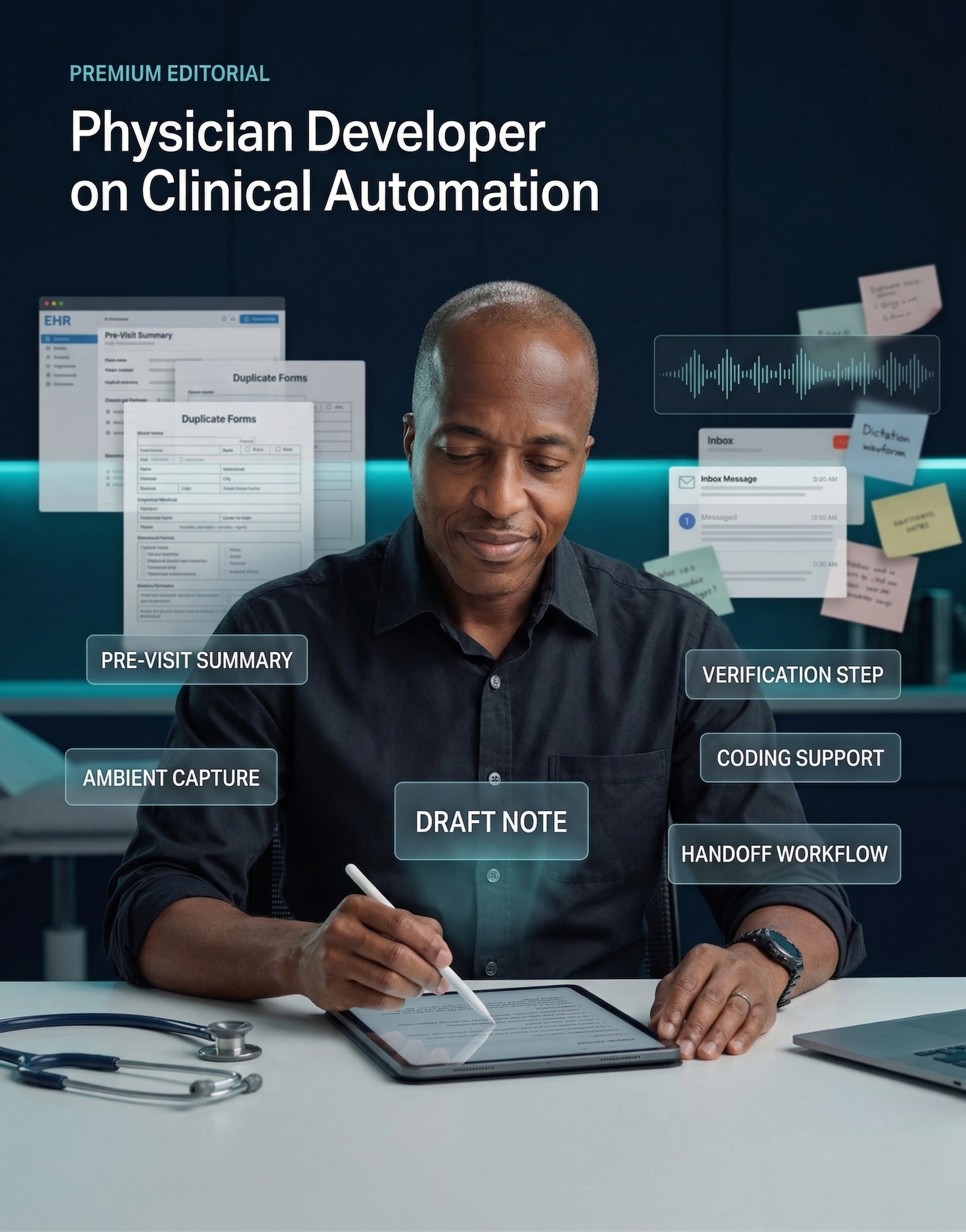
Clinical documentation automation is not about replacing the doctor. It is about removing friction around the doctor.
In medicine, people still talk about documentation as if it were a typing problem.
It is not.
It is a workflow problem, a cognitive burden problem, and often a fragmentation problem. Too much clinical time is spent reconstructing context, hunting for the right fact in the wrong tab, reassembling the patient story across disconnected systems, and then translating that story into a format the record will accept.
That is where documentation automation becomes interesting.
Not because it promises some magical future where the chart writes itself, but because it addresses a much more practical reality: physicians are spending too much judgment on work that should mostly consume time, and too much time on work that should barely require judgment.
That framing matters.
A clinical note is never just a pile of words. It is interpretation. It is prioritization. It is a record of what mattered, what changed, what remains unresolved, and what should happen next.
Machines can help assemble. They can help retrieve. They can help summarize. They do not own the meaning.
That still belongs to the physician.
The Framing Is Wrong
Most conversations about “AI documentation” start in the wrong place.
They begin with the model, the transcription layer, the ambient microphone, the drafting engine, or the vendor demo that suggests the note might simply disappear. But documentation was messy long before large language models entered the room.
The note lives inside a workflow full of interruptions, duplicate entry, incompatible software, billing requirements, template cruft, inbox spillover, and institutional habits nobody designed from first principles.
If the workflow is broken, a better model just writes into the brokenness faster.
That is why documentation is a workflow problem before it is a model problem.
What The Best Tools Actually Do
The strongest documentation tools are usually not the ones making the biggest claims.
They are the ones that reduce cognitive overhead around recall, summarization, and note assembly. They help the physician remember what happened. They pull forward the relevant data. They create a cleaner first draft. They reduce copying and pasting across fragmented systems.
That benefit is easy to underestimate because it does not always look dramatic in a product pitch.
But in real practice, the quiet win is often relief. It is the reduction in cognitive drag that comes from not having to rebuild the encounter from memory at the end of a long day.
Ambient scribes may improve burnout. They may improve eye contact. They may reduce pajama-time charting.
That does not automatically mean they create massive productivity gains. Often the real gain is not speed alone. It is preserved attention.
Upstream And Downstream Value
The real value of documentation automation often sits upstream and downstream at the same time.
Upstream, automation can help create a draft faster and with less mental strain. Downstream, it can produce cleaner structured inputs for coding, patient communication, handoff, longitudinal review, referral workflows, and decision support.
A better note is not just a better artifact for today.
It becomes better raw material for everything that comes after.
That is why physicians should care about note quality beyond compliance, and why physician-developers should care about structured outputs beyond generation.
If the first draft is cleaner, the entire downstream pipeline improves.
The Most Practical Problem In The Space
If I had to choose the most practical sub-problem in clinical documentation automation, I would choose summarization.
Before any dream of full automation succeeds, clinicians need help with chart review burden. They need orientation. They need a concise patient summary that explains why this patient is here, what the major problems are, what changed since the last visit, and what remains unresolved.
They need literature summaries that reduce the time required to understand a new paper without pretending that nuance can be outsourced. They need inbox compression that removes noise without erasing signal. They need referral synthesis that gets them to the important part faster.
That is real value.
A clinician opening a chart does not always need a masterpiece. Very often, they need a trustworthy on-ramp.
Clinical AI Becomes Useful When It Respects Sequence
Generic AI layers sound impressive in demos and often fail in practice for one simple reason: they do not fit the actual movement of clinical work.
They do not know where the friction lives. They do not understand that the physician may need one kind of summary before the encounter, another during the encounter, and a different kind after the encounter when coding, messaging, or follow-up begins.
Clinical AI becomes useful when it respects sequence.
First, orient me.
Then, help me capture.
Then, help me draft.
Then, help me verify.
Then, help me hand off, retrieve, bill, and follow through.
That is a workflow.
And workflows are where physician insight matters most.
The Real Design Question
The deepest question in this space is not technical. It is philosophical.
What part of the documentation workflow is actually consuming judgment, and what part is merely consuming time?
That may be the most important question in the field.
If a task requires contextual interpretation, clinical prioritization, moral accountability, or reasoning under uncertainty, the physician should remain firmly in control.
If a task is mostly clerical reconstruction, repetitive assembly, cross-system duplication, or first-pass summarization, automation has a legitimate role.
Not to replace the doctor, but to preserve the doctor for the work only the doctor can do.
That is the standard I keep coming back to.
We should not evaluate documentation automation by asking whether it can act like a physician. We should evaluate it by asking whether it protects physician judgment from being wasted on low-yield administrative drag.
That is a better design target.
It is also a more honest one.
What This Means For Practicing Physicians
If you are a practicing physician, the practical question is not whether the note can be generated.
The practical question is whether the system helps you stay present, think clearly, and verify efficiently without diluting your clinical voice.
A good documentation tool should help you:
- orient faster before the encounter
- capture the visit without forcing divided attention
- review a cleaner draft instead of rebuilding the story from scratch
- preserve nuance where judgment matters
- reduce downstream friction in coding, communication, and follow-up
If it cannot do those things, it is not saving you. It is just moving the burden.
What This Means For Physician-Developers
For physician-builders, this creates a very clear opportunity.
The future is probably not one giant model that “does documentation.” It is more likely a set of smaller, workflow-aware systems that solve specific note problems well.
That means:
- pre-visit chart synthesis
- ambient capture with structured extraction
- longitudinal problem summaries
- referral compression
- discharge summarization
- inbox summarization
- coding support
- literature condensation
Each of these is a bounded problem. Each is clinically meaningful. Each can reduce friction without pretending medicine is just pattern completion.
That is where serious builders should focus.
Not on replacing judgment.
On preserving it.
The Better Ambition
The best clinical documentation tools will not be the ones that make the doctor disappear.
They will be the ones that let the doctor stay present, think clearly, and move through the chart with less waste.
That is a much better ambition.
And it may be the one that actually works.
Related articles
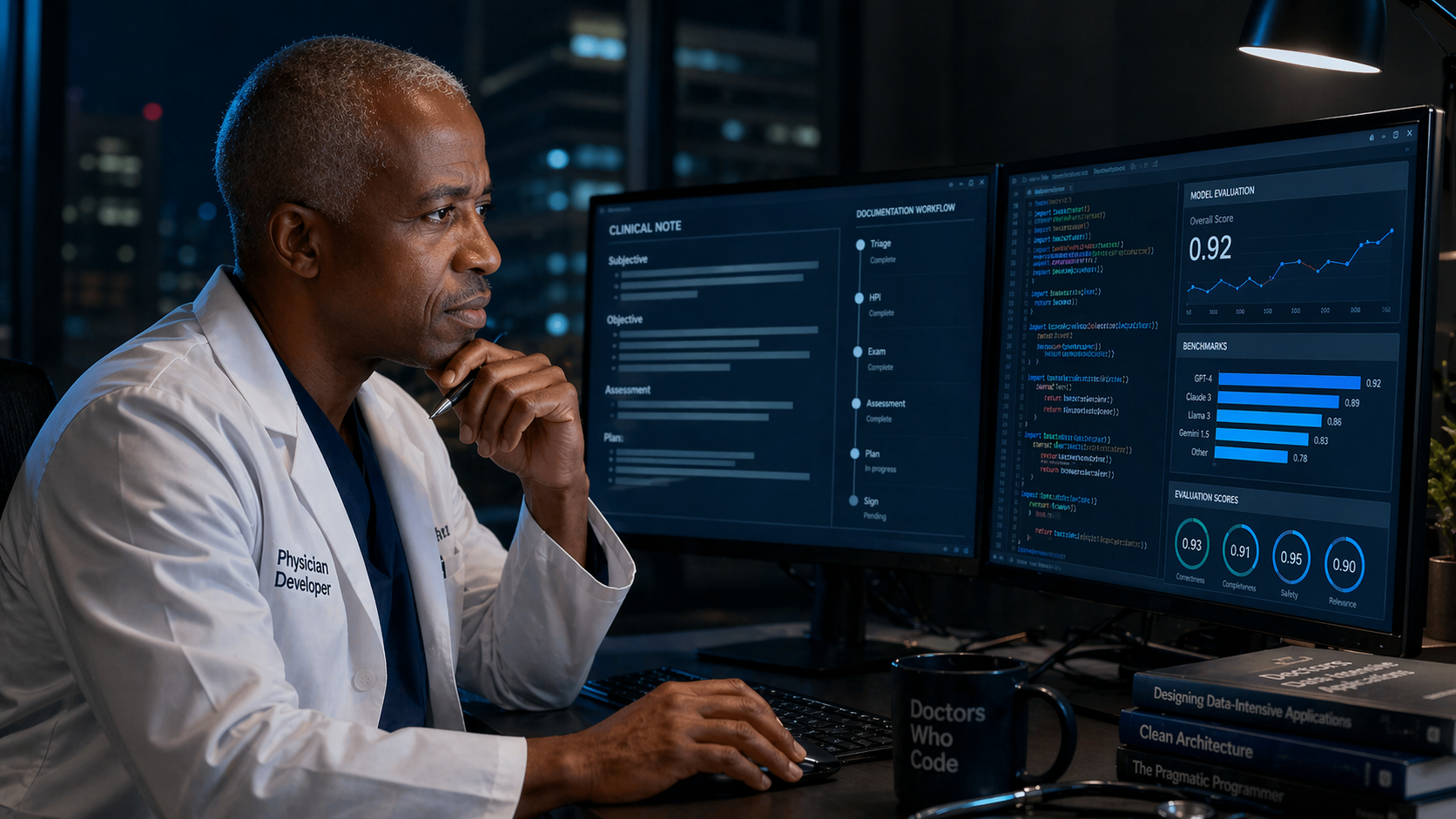
AI Just Outperformed Physicians at Clinical Writing. This Should Not Surprise You.
HealthBench Professional shows AI has already crossed the threshold in clinical writing and documentation. The real lesson is not replacement. It is that physician-developers need to build the harness.
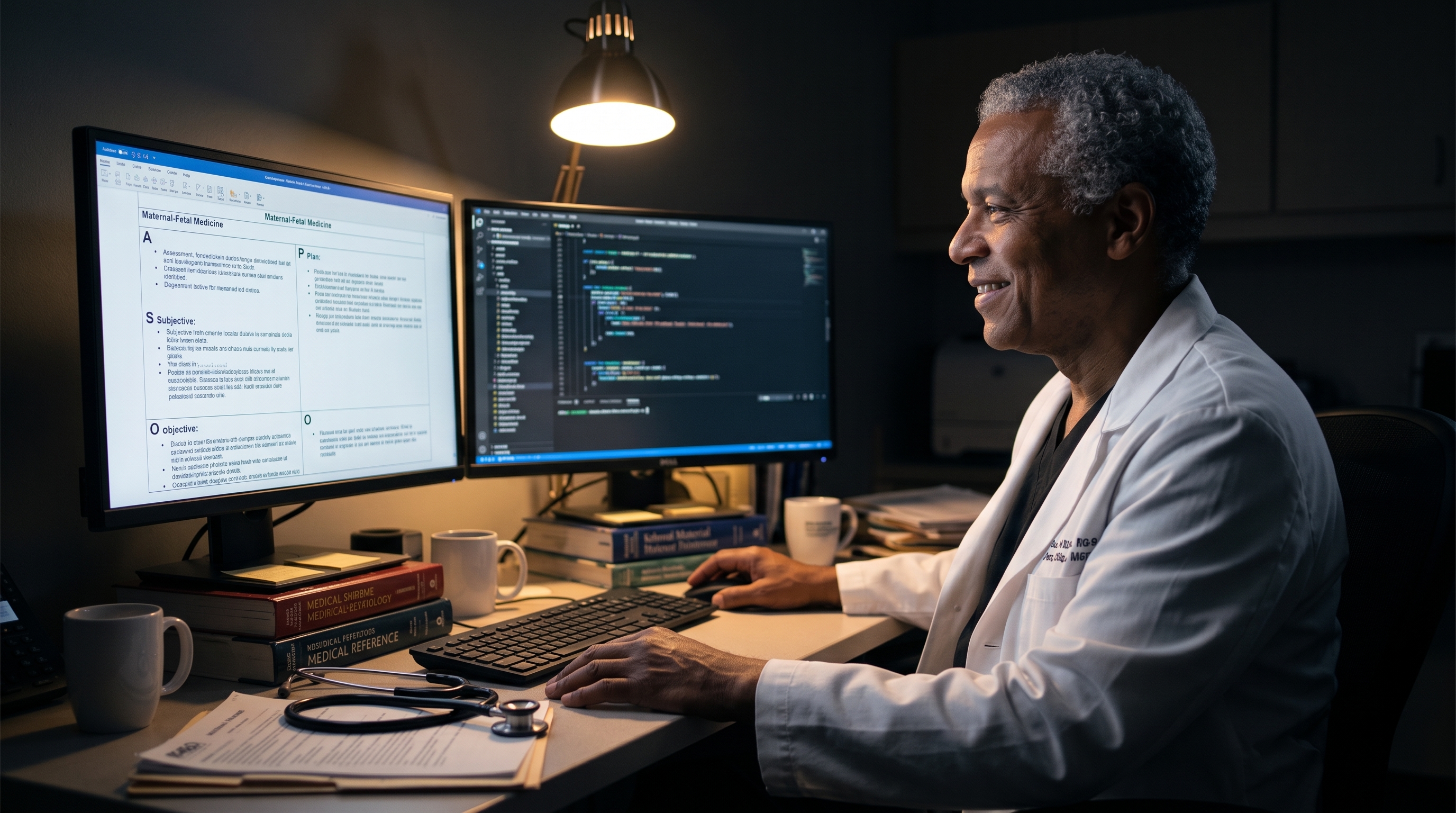
Surviving the AI-Native Transformation: A Physician-Developer's Guide
AI makes clinical software cheap to produce. It does not make it safe. Physician-developers must build systems in which speed remains subordinate to evidence, judgment, and the doctor-patient relationship.
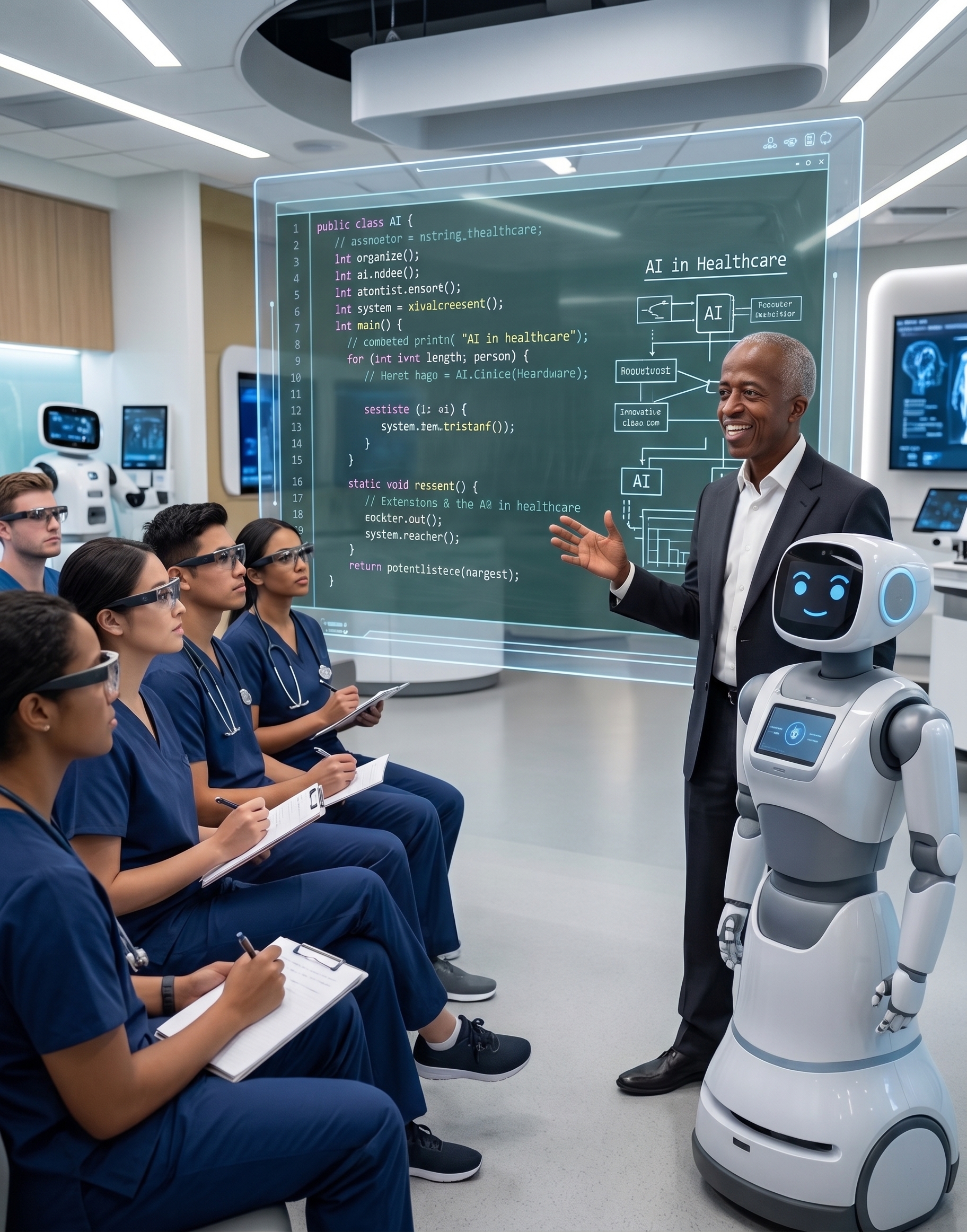
Medical Education Does Not Need an AI Course. It Needs a New Clinical Curriculum.
Preparing physicians for agentic AI requires more than an elective. Medical education must redesign how students reason independently, delegate work, verify machine output, and retain clinical judgment.
Maternal-Fetal Medicine Specialist