Navigating Medical AI on GitHub: What Is Worth Your Time
There are thousands of medical AI repositories on GitHub. Most are abandoned, half-built, or unreproducible. Here is how to find the ones that actually work.
Listen to this post
Navigating Medical AI on GitHub: What Is Worth Your Time
On this page8 sections
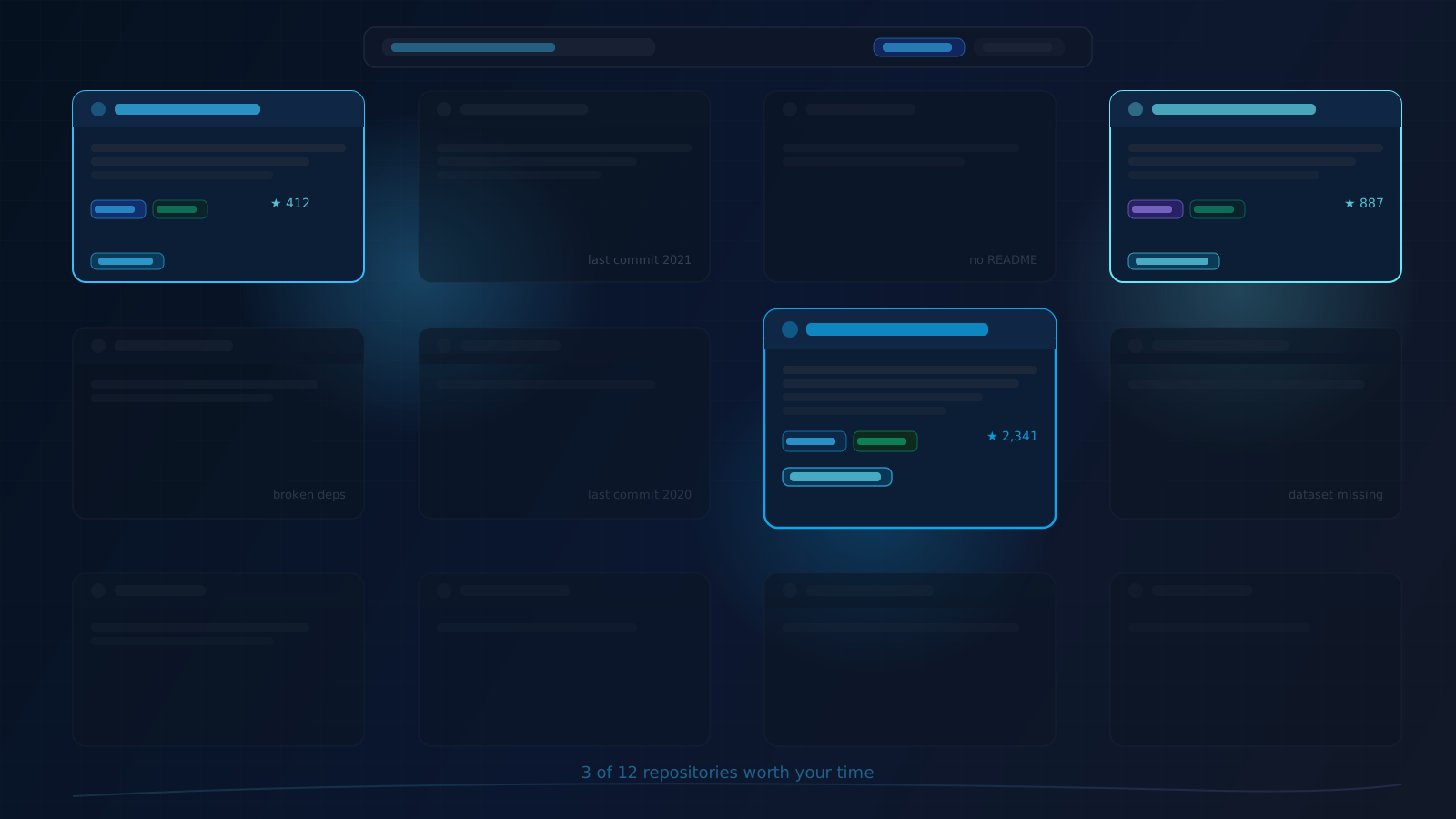
I spent an afternoon in early 2024 searching GitHub for preeclampsia prediction models. I found thirty-seven repositories. Six had no README. Fourteen had not been updated in over two years. Four required datasets that no longer existed at the referenced URLs.
Three were actually useful.
That ratio is not unusual. It is the honest state of open-source medical AI. Understanding how to find the three that work, and not waste time on the other thirty-four, is a practical skill for any physician-developer.
Why Most Medical AI Repositories Are Not What They Appear
A GitHub repository is a snapshot. It shows you what someone committed, but it does not tell you whether that code runs today, whether the model was ever validated on external data, or whether the author is still maintaining it.
Repositories accumulate over time. A model trained in 2020 on a dataset from a single academic center may have hundreds of stars and look authoritative. The star count reflects when it was shared, not whether it is production-ready.
This is a different problem than you face in clinical literature. A PubMed paper has a journal, peer review, and a DOI. A GitHub repo has a README that the author wrote themselves.
Evaluate them accordingly.
What to Look for Before You Clone Anything
Before you run git clone on a medical AI project, check four things:
Last commit date. Any repository with no commits in twelve months is likely unmaintained. For AI projects specifically, this matters because dependencies change fast. A TensorFlow 1.x model from 2019 may require significant work to run in a modern environment.
Issue tracker activity. Open the Issues tab. Are questions being answered? Are bugs being fixed? A dead issue tracker is a signal the project is orphaned.
Reproducibility documentation. Does the README tell you exactly how to run it? Does it specify the dataset, the preprocessing steps, and the expected output? If you cannot reproduce the results from the documentation alone, it is not ready to build on.
License. Medical AI projects often use data from institutional datasets. Some repositories have restrictive licenses that prohibit clinical use. Check this before investing time.
The Libraries That Actually Matter
Most physician-developers starting out see a long list of AI frameworks and do not know which ones to learn. The honest answer is that two are worth your time, and the rest are secondary.
Python + scikit-learn for classical machine learning. Risk calculators, clinical prediction rules, tabular data models. scikit-learn has been stable for over a decade and has the best documentation in the ecosystem.
PyTorch for deep learning and anything involving medical imaging or NLP. Most serious medical AI research now publishes PyTorch implementations. If you see a paper with a GitHub link, it is usually PyTorch.
TensorFlow is still widely used but PyTorch has become the dominant research framework. For a physician starting in 2026, learning PyTorch first is the right call.
The JavaScript libraries that sometimes appear in “physician GitHub” listicles, TensorFlow.js and Brain.js, are mostly browser toys. They have legitimate uses in lightweight web-based clinical tools, but they are not where the serious medical AI work happens.
Where to Find Repositories Worth Cloning
GitHub search with the right filters gets you most of the way there.
topic:medical-ai stars:>50 pushed:>2024-01-01This filters for medical AI repositories with some community validation (50+ stars) that have been updated recently. You will still need to evaluate each one against the criteria above, but it eliminates most of the abandoned work.
A few reliable entry points:
Harvard Medical School and Stanford AI in Medicine both maintain active GitHub organizations. Their repositories are generally well-documented and maintained.
fast.ai’s medical imaging notebooks. Not a repository in the traditional sense, but the course materials include real medical imaging pipelines using actual DICOM data.
MONAI (Medical Open Network for AI). This is the most actively maintained medical imaging AI framework I have encountered. It is built on PyTorch, it is properly documented, and it has an active community. If you are interested in imaging AI, start here.
pip install monaiThe Honest Limitation
Nothing on GitHub replaces clinical validation. An open-source model that classifies skin lesions has been trained on someone’s dataset, validated on that same group’s test set, and published. That tells you the model works under those specific conditions.
Deploying it in your practice means validating it in your patient population, with your imaging equipment, in your clinical workflow. This is not a software problem. It is an epidemiology problem.
The FDA’s Software as a Medical Device framework applies to any AI tool used in clinical decision-making. Knowing that a model exists on GitHub and knowing that you can use it clinically are different things.
Build on what you find on GitHub. But validate it before you treat a patient based on its output.
The Practical Starting Point
The most useful thing you can do in your first week exploring medical AI on GitHub is not to build anything. It is to find one well-maintained repository in an area you care about clinically, read its code, run its examples, and understand what it is actually doing.
That process teaches you more than any tutorial about what real medical AI code looks like, what its limitations are, and where you might contribute something new.
Once you have done that, you are ready to start building your own.
The next post in this series covers choosing your first medical AI project and shipping something that works.
Keep Going
Finding a promising repository is not the same as choosing a project you can actually finish. Discernment comes first. Scope comes next.
Read Your First Medical AI Project on GitHub: How to Choose One You Will Actually Finish.
Doctors Who Code Series
This post is part of the Doctors Who Code series, a practical roadmap for physicians who want to build software, understand clinical data, and move into medical AI without hype.
Related articles
Your First Medical AI Project on GitHub: How to Choose One You Will Actually Finish
Most physician-developers never ship their first AI project. The problem is not skill. It is scope. Here is a framework for choosing a project that lands.
Doctors Who Code: From GitHub to Medical AI
A practical path for physicians who want to move from GitHub basics to building real medical AI projects.
The Future of Clinical Documentation: A Practical AI Tech Stack for Physicians Who Code
> Keywords: AI clinical documentation, ambient transcription, EvidenceMD, CodeCraftMD, physician automation, clinical workflow, medical billing automati...

Maternal-Fetal Medicine Specialist