Your First Medical AI Project on GitHub: How to Choose One You Will Actually Finish
Most physician-developers never ship their first AI project. The problem is not skill. It is scope. Here is a framework for choosing a project that lands.
Listen to this post
Your First Medical AI Project on GitHub: How to Choose One You Will Actually Finish
On this page 10 sections
I have watched at least a dozen physicians start AI side projects and abandon them before anything ran. The pattern is almost always the same. They start with an ambitious goal, spend two weeks on infrastructure, and then stop.
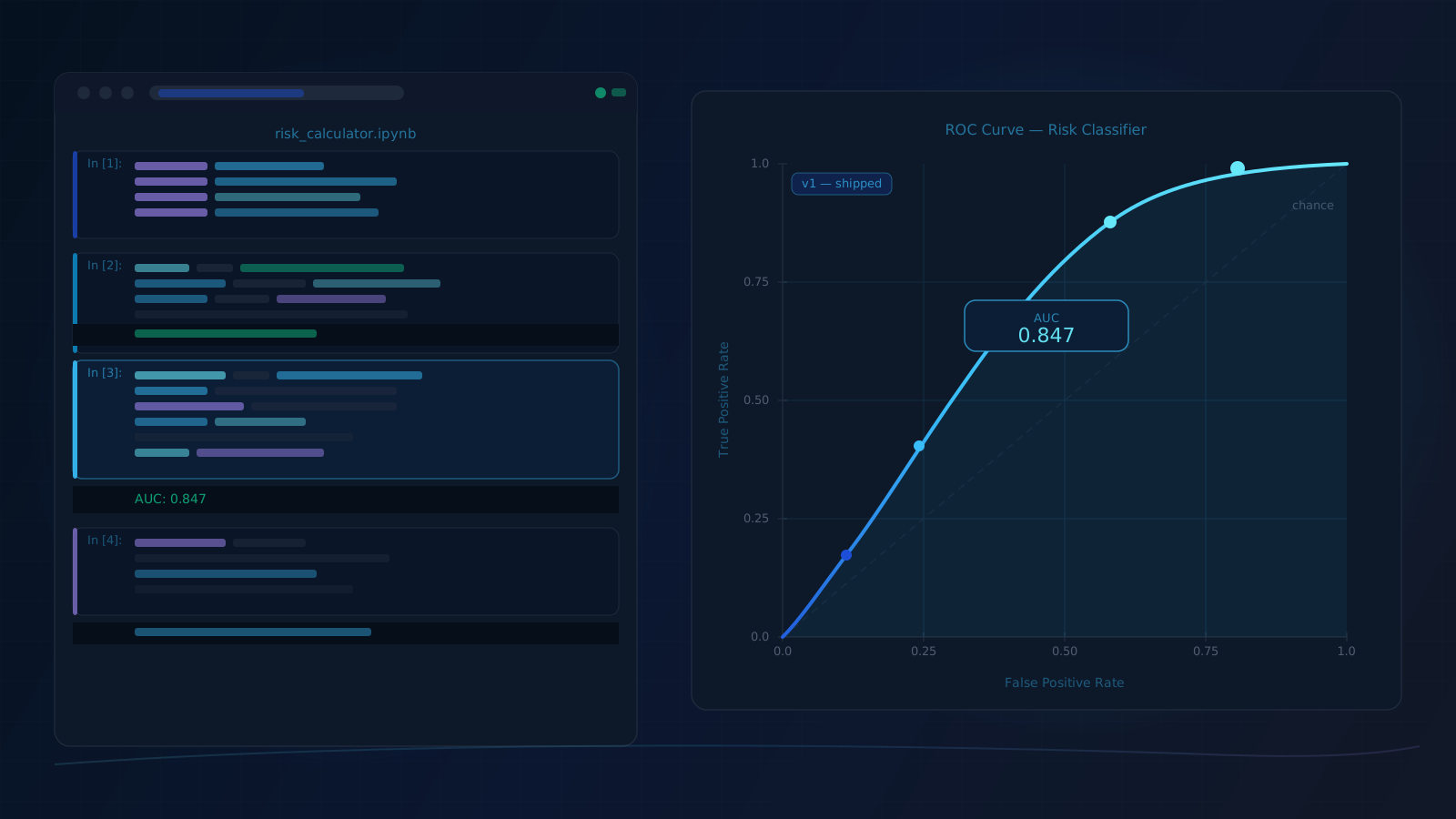
The project I finished was a gestational hypertension risk calculator. It took about a weekend. It ran. I used it.
The one before it was going to analyze DICOM files from our unit’s fetal echo studies. It never ran at all.
The difference was not skill. It was scope.
Why Scope Kills Physician-Developer Projects
You have a specific window of time for a project like this. A weekend here, an evening there, maybe a focused week during a lighter clinical rotation. That is real, and it is enough, but only if the project fits inside it.
The mistake is choosing a project based on what would be most impressive or most impactful at full scale. A de-identification pipeline for clinical notes would be genuinely useful. So would a fetal echo DICOM classifier. But neither of those projects has a natural stopping point after a weekend of work. You will hit the hard parts and have nothing to show for the time you spent.
Choose a project where version one ships. Everything else is version two.
The Right Criteria for a First Project
A first medical AI project should meet three conditions:
You can describe what it does in one sentence. If the description requires and-then-and-then, it is too large. “It takes a patient’s age, BMI, blood pressure, and gestational age and outputs a preeclampsia risk score” is a project. “It analyzes the EHR and surfaces relevant risk factors and suggests interventions” is not.
The data is already available to you. Do not build a project that requires you to first solve a data acquisition problem. Use a public dataset, your own clinical observations quantified in a spreadsheet, or synthetic data. MIMIC-IV is a publicly available critical care dataset from MIT that many first projects use. The CDC’s PRAMS data covers pregnancy risk factors. Start with what you can access in a day.
You already know what correct output looks like. This is the clinical knowledge advantage physicians have and almost never use. If you are building a risk calculator, you already know what a high-risk result should look like from clinical practice. That means you can validate whether your model is producing sensible output without a formal holdout study.
Three Projects Worth Building First
These are not the most impressive AI projects a physician can build. They are the ones that teach you the most while being completable in a realistic timeframe.
A Clinical Risk Calculator with scikit-learn
Take any validated clinical scoring tool, the qSOFA score, the BISHOP score, the sFlt-1/PlGF ratio for preeclampsia, and rebuild it as a machine learning model trained on a public dataset rather than hardcoded weights.
This teaches you the full pipeline: data loading, preprocessing, train/test split, model fitting, evaluation. It produces something clinically interpretable because you already know what the score means.
from sklearn.linear_model import LogisticRegression
from sklearn.model_selection import train_test_split
from sklearn.metrics import roc_auc_score
import pandas as pd

# Load your dataset
df = pd.read_csv('maternal_risk_data.csv')

X = df[['age', 'systolic_bp', 'diastolic_bp', 'blood_glucose', 'body_temp', 'heart_rate']]
y = df['risk_level']

X_train, X_test, y_train, y_test = train_test_split(X, y, test_size=0.2, random_state=42)

model = LogisticRegression(max_iter=1000)
model.fit(X_train, y_train)

auc = roc_auc_score(y_test, model.predict_proba(X_test)[:, 1])
print(f"AUC: {auc:.3f}")
This is ten minutes of code. The work is in the data and the interpretation.
A Clinical Note Keyword Extractor
Natural language processing for clinical text does not require a large language model to be useful. A simple pipeline that identifies symptom terms, negations, and relevant history in a note teaches you how NLP works and produces something genuinely applicable to documentation workflows.
The spaCy library with en_core_sci_md from scispaCy handles medical
terminology out of the box.
import spacy

# pip install scispacy
# pip install https://s3-us-west-2.amazonaws.com/ai2-s2-scispacy/releases/v0.5.3/en_core_sci_md-0.5.3.tar.gz

nlp = spacy.load("en_core_sci_md")

note = """
Patient presents at 34 weeks with headache and visual changes.
Blood pressure 158/104. No history of chronic hypertension.
Urine protein 2+. No fever.
"""

doc = nlp(note)
entities = [(ent.text, ent.label_) for ent in doc.ents]
print(entities)
The output will be imperfect. That is part of the learning. You will immediately see where the model fails clinically, which tells you something real about the state of medical NLP.
A Literature Search Summarizer with the Claude API
This is higher-level than the previous two and requires an API key, but it produces something you will actually use in clinical practice.
The project: take a clinical question, run a PubMed search using the Entrez API, pull the abstracts of the top ten results, and summarize them with Claude.
import anthropic
from Bio import Entrez

Entrez.email = "your@email.com"

def search_pubmed(query, max_results=10):
    handle = Entrez.esearch(db="pubmed", term=query, retmax=max_results)
    record = Entrez.read(handle)
    return record["IdList"]

def fetch_abstracts(pmid_list):
    ids = ",".join(pmid_list)
    handle = Entrez.efetch(db="pubmed", id=ids, rettype="abstract", retmode="text")
    return handle.read()

def summarize_with_claude(abstracts, question):
    client = anthropic.Anthropic()
    message = client.messages.create(
        model="claude-opus-4-6",
        max_tokens=1024,
        messages=[
            {
                "role": "user",
                "content": f"Clinical question: {question}\n\nAbstracts:\n{abstracts}\n\nSummarize the key findings relevant to this question."
            }
        ]
    )
    return message.content[0].text

# Example usage
question = "What is the sensitivity of sFlt-1/PlGF ratio for preeclampsia before 34 weeks?"
pmids = search_pubmed(question)
abstracts = fetch_abstracts(pmids)
summary = summarize_with_claude(abstracts, question)
print(summary)
This is a working clinical tool. It is not a toy. Every piece of it is replaceable as your skills grow.
How to Structure the Repository
Once you have something running, put it on GitHub. The structure does not need to be complex:
my-risk-calculator/
├── README.md          ← What it does, how to run it, what data it needs
├── requirements.txt   ← pip install -r requirements.txt
├── data/
│   └── sample_data.csv
├── notebooks/
│   └── exploration.ipynb
└── src/
    └── model.py
A README that lets another physician run your code in thirty minutes is more useful than a complex architecture.
The Real Measure of Success
The measure of a successful first project is not accuracy. It is completion.
A model with 0.75 AUC that you shipped, documented, and understand is worth more than a model with 0.92 AUC that you abandoned in a Jupyter notebook.
The skill that matters most in physician-developer work is the ability to take a project from idea to running code, repeatedly. You build that skill by shipping things, including things that are imperfect.
Version two is better than version one. But only if version one exists.
This is the last post in a series on GitHub and medical AI for physician-developers. Start with why you need version control before anything else, or go back to how to find medical AI repositories worth building on.
Keep Going
The goal is not to admire medical AI from a distance. It is to build something small, clinical, and real.
If you want the full path from first GitHub account to first medical AI build, start at the beginning with Stop Lurking: Why Physicians Should Start GitHub Before They Feel Ready.
Doctors Who Code Series
This post is part of the Doctors Who Code series, a practical roadmap for physicians who want to build software, understand clinical data, and move into medical AI without hype.
Related articles
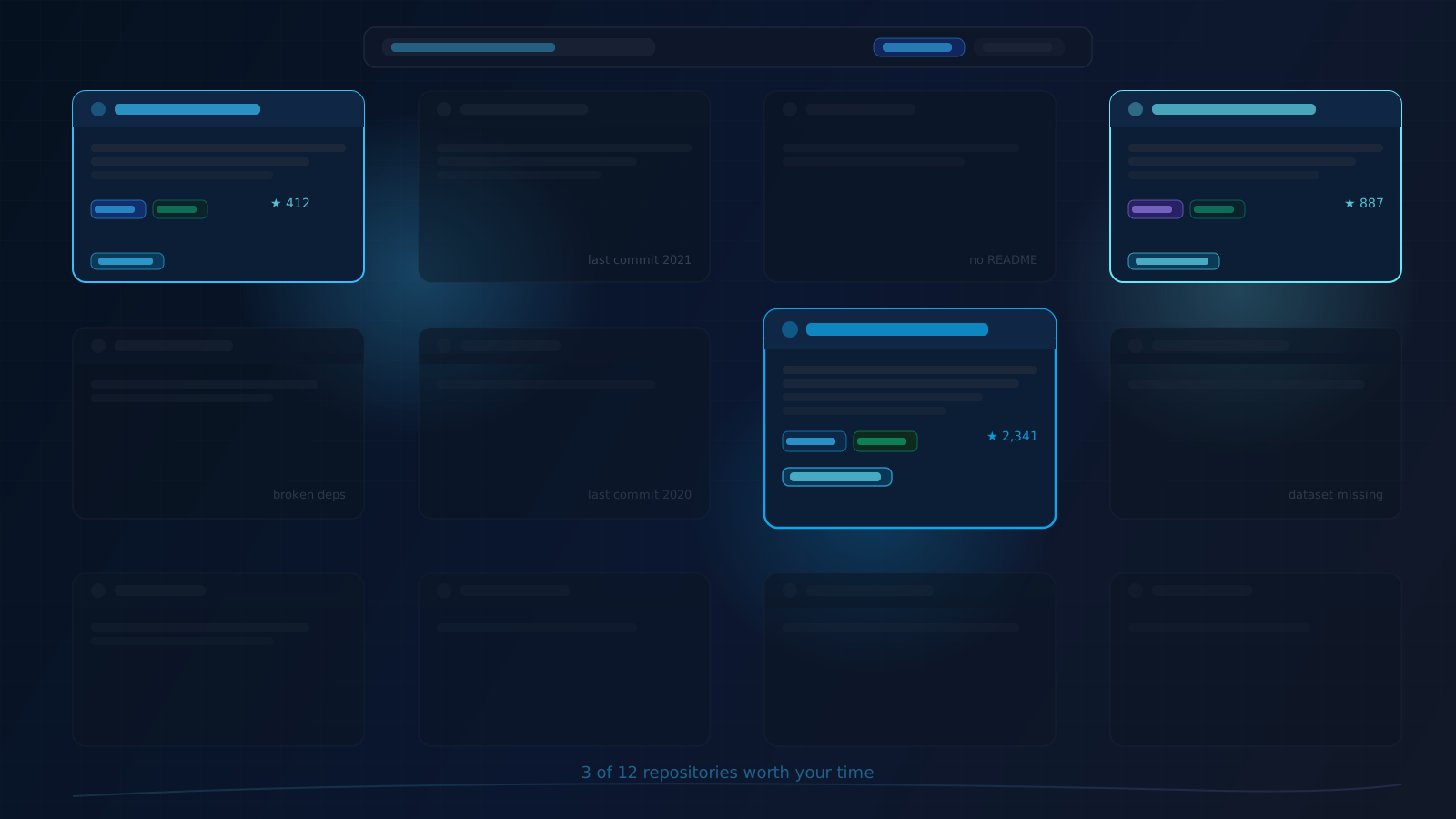
Navigating Medical AI on GitHub: What Is Worth Your Time
There are thousands of medical AI repositories on GitHub. Most are abandoned, half-built, or unreproducible. Here is how to find the ones that actually work.
The Future of Clinical Documentation: A Practical AI Tech Stack for Physicians Who Code
> Keywords: AI clinical documentation, ambient transcription, EvidenceMD, CodeCraftMD, physician automation, clinical workflow, medical billing automati...
Doctors Who Code: From GitHub to Medical AI
A practical path for physicians who want to move from GitHub basics to building real medical AI projects.

Maternal-Fetal Medicine Specialist