What Is Machine Learning?
Ive recently started reading Why Machines Learn by Anil Ananthaswamy, a book that traces the elegant mathematics behind modern artificial intelligence....
Listen to this post
What Is Machine Learning?
On this page 7 sections
Reflections from reading Anil Ananthaswamy’s Why Machines Learn
Deep Dive Podcast:
📖 Introduction
I’ve recently started reading Why Machines Learn by Anil Ananthaswamy, a book that traces the elegant mathematics behind modern artificial intelligence. As I work through the chapters, I want to practice “reading in public” — sharing insights while the ideas are still fresh, instead of waiting until I’ve finished the entire book.
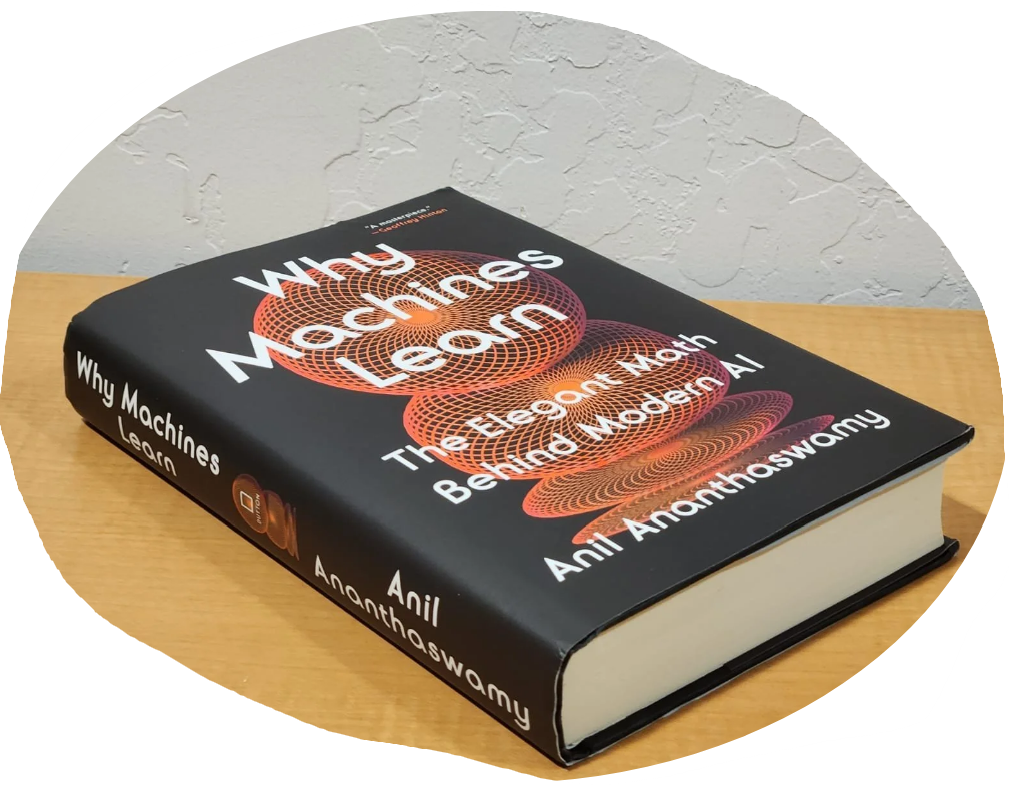
Machine learning (ML) is everywhere: from voice assistants and recommendation engines to self-driving cars and medical imaging. Yet at its heart, it’s not magic — it’s mathematics. In this post, I’ll outline what machine learning actually is, drawing on the definitions and framing in Ananthaswamy’s book.
🧩 Defining Machine Learning
One of the earliest pioneers, Arthur Samuel, described ML as giving computers the ability to learn without being explicitly programmed.
Later, Tom Mitchell offered a more precise definition:
A computer program is said to learn from experience E with respect to some class of tasks T and performance measure P, if its performance at tasks in T, as measured by P, improves with experience E.
This definition captures three essentials:
-
Task (T): What the system is trying to do.
-
Experience (E): The data it is exposed to.
-
Performance (P): How well it gets better at the task.
At its core, ML is about discovering patterns in data and improving performance through exposure and feedback.
🔍 How ML Differs from Traditional Programming
-
Traditional programming: You write explicit rules (e.g., if blood pressure > 140, then flag as hypertensive).
-
Machine learning: You provide data, and the system infers the rules (e.g., the model learns to detect hypertension patterns from thousands of patient records).
A simple analogy: Traditional programming is like writing a recipe step by step. Machine learning is like teaching someone to cook by giving them ingredients, watching them experiment, and letting them refine the dish over time.
🧠 Three Main Types of Machine Learning
-
Supervised Learning
-
Learn from labeled examples (input → output).
-
Example: Predicting birth weight from ultrasound measurements.
-
-
Unsupervised Learning
-
Find hidden structure in unlabeled data.
-
Example: Grouping patients with similar lab profiles into meaningful clusters.
-
-
Reinforcement Learning
-
Learn through trial and error, guided by rewards or penalties.
-
Example: An insulin pump adjusting delivery based on blood glucose feedback.
-
📐 Why the Math Matters
Ananthaswamy’s central thesis is that the beauty of ML comes from mathematics:
-
Linear algebra gives the language for data representation.
-
Calculus enables optimization (e.g., gradient descent).
-
Probability handles uncertainty.
You don’t need to be a mathematician to appreciate this elegance, but these tools make learning possible. Over the next posts, I’ll unpack how seemingly simple mathematical structures fuel some of the most powerful technologies of our time.
🌍 Why It Matters
Machine learning is not just a technical curiosity. It has implications for:
-
Healthcare: predicting risks, personalizing treatments.
-
Society: shaping economies, politics, and culture.
-
Ethics & spirituality: raising questions about agency, trust, and responsibility.
For me, as both a physician and a student of theology, these questions are deeply personal.
✨ Conclusion & Invitation
Machine learning is the science of teaching computers to improve from data. It’s adaptive, predictive, and increasingly influential.
In Why Machines Learn, Ananthaswamy shows how elegant math underlies this power. I’ll continue sharing reflections as I read, especially when we dive deeper into the mathematics that make ML possible.
👉 Question for you: Where do you see machine learning already shaping your daily life?
Chuck
Related articles
The Future of Clinical Documentation: A Practical AI Tech Stack for Physicians Who Code
> Keywords: AI clinical documentation, ambient transcription, EvidenceMD, CodeCraftMD, physician automation, clinical workflow, medical billing automati...
The Optimization Trap: What With Folded Hands Can Teach Us About AI in Medicine
Jack Williamson's 1947 story imagined machines that obeyed humanity perfectly and destroyed it anyway. Medicine is building the same objective function.

How I Used Code (and AI) to Fix One of Healthcare’s Most Painful Bottlenecks: Prior Authorizations
Specifically, the Prior Authorization (PA).
Maternal-Fetal Medicine Specialist