A Protocol Is a Memory System, Not a Patient
Clinical protocols reduce avoidable variation, but software must preserve their population boundaries, exceptions, provenance, and judgment points.
In This Lesson
Read with a defined objective.
Learning objectives
- Define the applicability boundary of a clinical protocol.
- Create a protocol map with explicit exceptions and judgment points.
- Preserve source, version, and local adaptation metadata.
Prerequisites
- A completed evidence card from Lesson 1.
Build Medical Software From Evidence to Software
Listen to this post
A Protocol Is a Memory System, Not a Patient
On this page 5 sections
Course lessons 5 lessons
In this course
From Evidence to SoftwareThe protocol PDF is open. The patient fits the first three criteria and misses the fourth by one detail that the summary table never anticipated.
This is not a failure of evidence-based medicine. It is the reason clinical judgment exists.
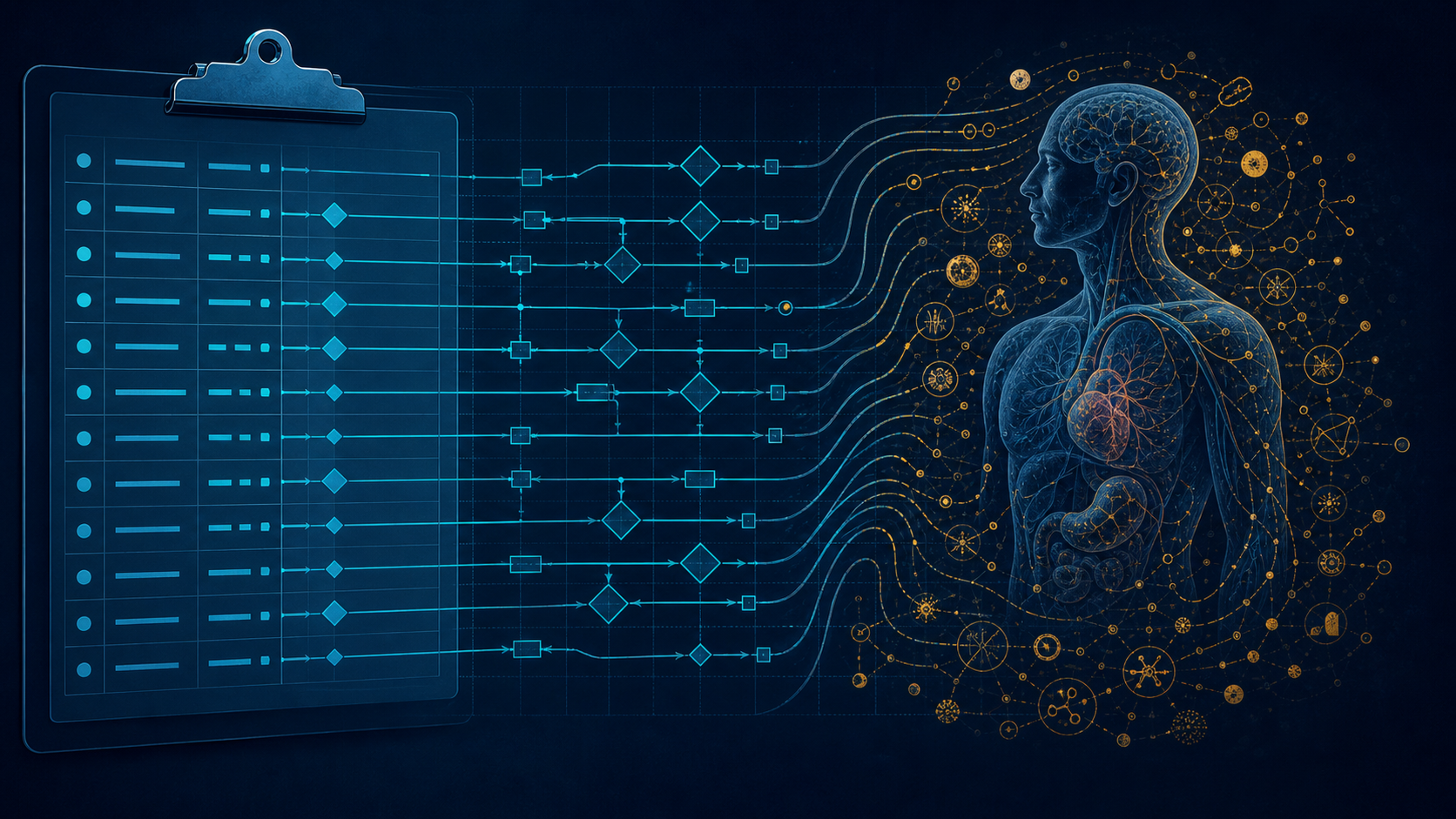
A protocol is a memory and safety system. It carries a professional organization’s best current recommendation into a busy clinical environment. It reduces avoidable variation. It keeps a consequential threshold from depending on whether someone remembers the correct number at the end of a long call night.
But a protocol is still a model of reality.
The Applicability Boundary
Every protocol has an applicability boundary. Inside that boundary, the recommendation describes the intended population and clinical setting. Outside it, the same recommendation may become unsupported, incomplete, or wrong.
The boundary is often distributed across the document:
- inclusion and exclusion criteria;
- footnotes beneath a table;
- definitions from an earlier section;
- exceptions described only in prose;
- assumptions about local resources;
- cautions that do not fit into the main algorithm.
These details are easy to miss when a protocol is read quickly. They are even easier to erase when it is converted into software.
Decompose the Protocol Before You Simplify It
Do not begin by asking what the app should display. Begin by taking the protocol apart.
Create a protocol map with six categories:
- Inputs. What patient facts does the recommendation require?
- Decision points. Which facts change the branch?
- Outputs. What action, interval, classification, or recommendation follows?
- Exceptions. Which conditions interrupt the ordinary sequence?
- Sources. Which guideline section supports each rule?
- Judgment points. Where must a clinician interpret, individualize, or decline the recommendation?
The judgment points are not defects waiting to be automated. They are part of the design.
Protocols Need Provenance
A protocol without a source is advice. A protocol without a date is a future liability.
The software version should retain the sponsoring organization, document title, publication date, relevant section, local adaptation, and last clinical review date. If the institution modified the national recommendation, record that difference explicitly.
I have argued elsewhere that a protocol assistant needs retrieval, provenance, and source freshness. The same standard applies to a calculator or decision tree. The interface should never make a locally adapted rule look like universal evidence.
Conflicts Are Data
Professional organizations sometimes disagree. A local protocol may differ from a national guideline. A recommendation may change while the older document remains in circulation.
Do not resolve that conflict silently in code.
Record which source governs the application and why. If more than one pathway is defensible, represent the disagreement or narrow the application’s intended use. Hidden reconciliation creates false certainty.
Your Exercise
Select one protocol that matters in your practice. Build its protocol map.
Circle every exclusion. Mark every statement that requires interpretation. Add the source and review date beside every consequential threshold. Then write the sentence the eventual application must show when the patient falls outside the protocol.
The protocol organizes the recommendation. It does not contain the patient.
Related articles

Evidence Is Not Yet a Clinical Instruction
Clinical evidence describes populations. Physician-developers must preserve its limits before translating it into protocol logic or software.
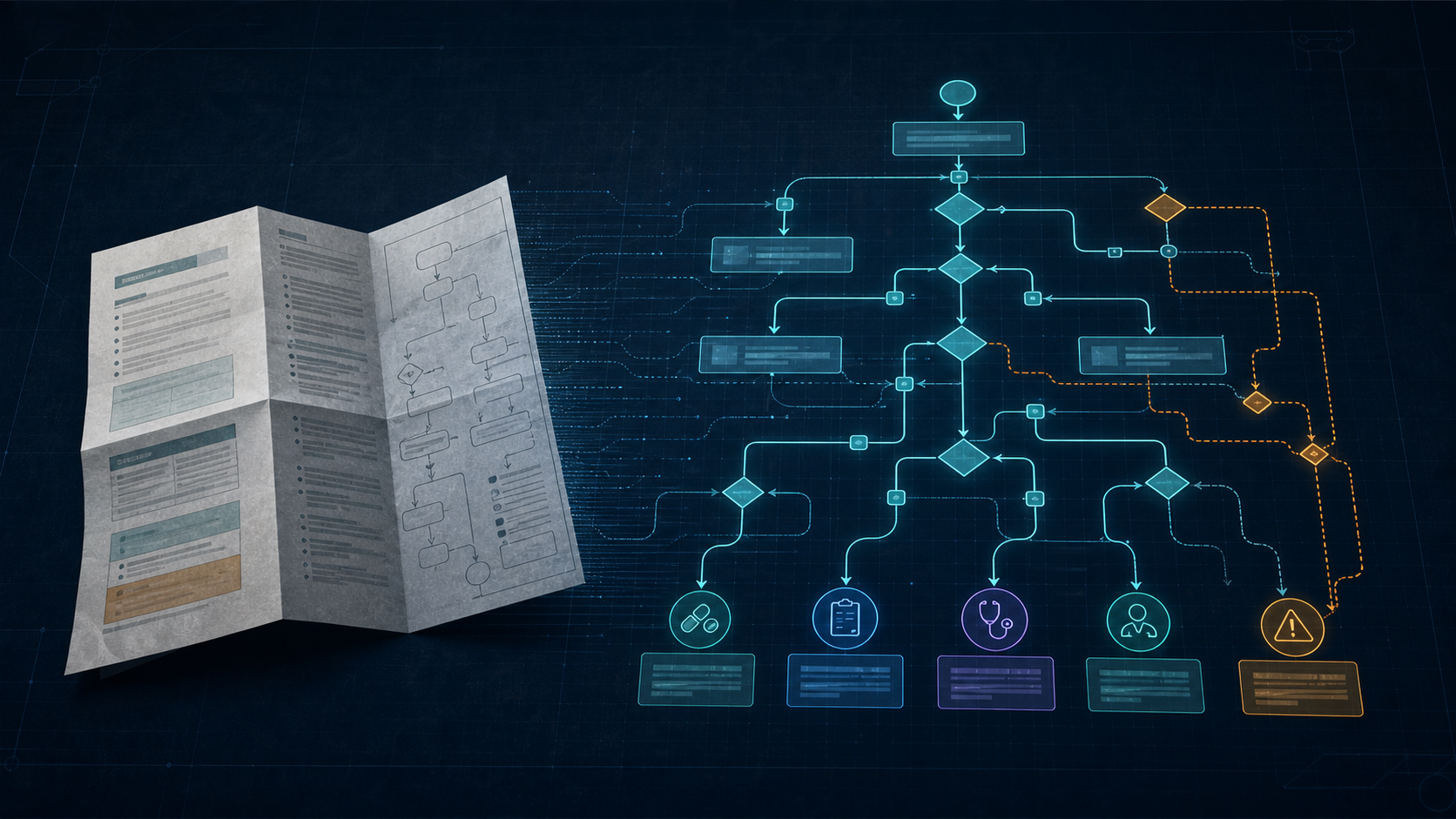
Make the Clinical Logic Visible Before You Code
Translate a clinical protocol into explicit inputs, branches, thresholds, exceptions, and failure states before choosing a programming language.
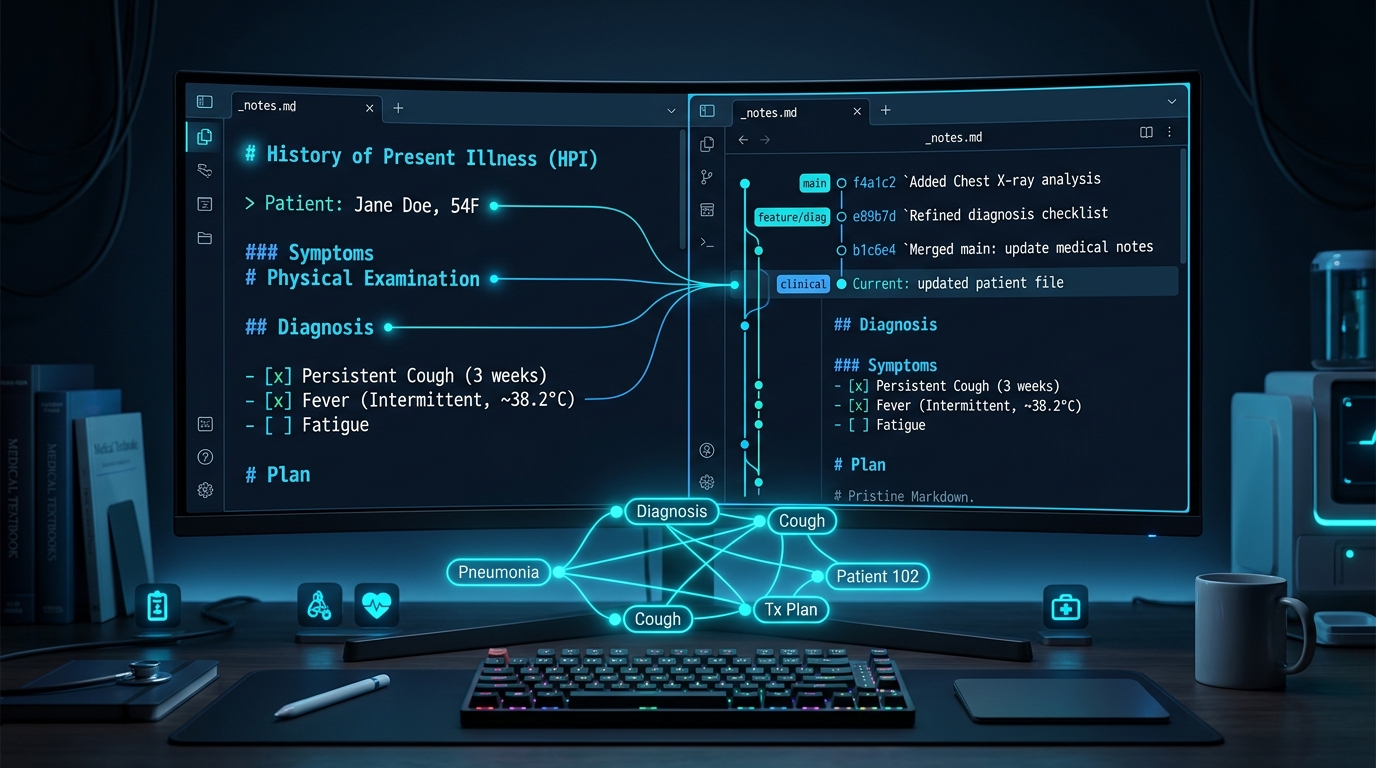
Why Every Physician-Developer Should Learn Markdown
Markdown is not just a writing format. For physician-developers, it is the connective tissue between clinical thinking, documentation, GitHub, AI workflows, and build-in-public learning.

Maternal-Fetal Medicine Specialist