The End of the Implementation Bottleneck: Why Clinicians Who Code Are the Future of Healthtech
AI agents are making implementation cheaper. In healthtech, the advantage moves to clinicians who can preserve clinical truth and supervise the architecture.
Listen to this post
The End of the Implementation Bottleneck: Why Clinicians Who Code Are the Future of Healthtech

On this page 9 sections
Around sixteen minutes into a five-hour conversation, David Heinemeier Hansson described a software release he did not program by hand.
The release was Omarchy Quattro. DHH shaped it, reviewed it, and directed the work. AI agents wrote the code that shipped.
Then he described the opposite result.
At 37signals, designers were given AI coding tools and encouraged to build the features they wanted. The individual pull requests often looked reasonable. Taken together, they damaged the architecture of Basecamp. Experienced programmers had to restore the coherence of the system by hand.
The same technology produced both outcomes.
One had architectural direction. One had local speed without system stewardship.
That distinction matters far beyond software companies. It describes the opportunity and the danger now arriving in healthtech.
AI agents are reducing the cost of implementation. They are not reducing the cost of judgment.
For clinicians who code, that changes the shape of the field.
I. Quattro Is Evidence, Not a Shortcut
In my previous post, I described how to turn a spare computer into an Omarchy development laboratory.
The point of that laboratory was not Linux.
It was to create a place where a physician could move through one complete build loop:
Clinical question
      ↓
Evidence review
      ↓
Explicit specification
      ↓
Synthetic test cases
      ↓
Implementation
      ↓
Automated tests
      ↓
Physician review
      ↓
Versioned release
Quattro makes that laboratory more consequential.
DHH did not prove that software knowledge no longer matters. He proved that a person with deep technical judgment can convert intention into working software at a speed that was recently impossible.
He knew what he wanted the operating system to become. He understood the codebase beneath it. He could review the shape of the output, recognize when the system drifted, and decide what belonged in the release.
The agents supplied implementation capacity.
He supplied direction.
That is agentic engineering. It is not the absence of expertise. It is expertise operating at a higher level of leverage.
II. Vibe Coding Fails at the Boundaries
The Basecamp example is the warning label.
A feature can work and still weaken the system that contains it. A pull request can pass its local tests and still introduce a second way to represent the same state. A screen can look correct while bypassing the authorization, validation, or audit path that makes the application trustworthy.
AI makes these failures easier to produce because it makes plausible implementation abundant.
That is dangerous in healthcare.
A prenatal risk tool does not become safe because every button works. The gestational-age model must be consistent. Missing data must remain different from a negative finding. Units must be explicit. Threshold behavior must be tested at the boundary. The evidence source and review date must remain visible. Patient data must not cross into an unapproved model, log, or development environment.
These are architectural decisions.
They determine whether clinical meaning survives translation into software.
I use a three-error check when reviewing agent-assisted work:
- What did it add? Inspect new dependencies, files, claims, and pathways.
- What did it change? Review the diff, the tests, and the clinical behavior.
- What did it leave out? Re-read the exclusions, boundary cases, and failure states.
The third question is where fluent systems often fail.
An AI agent can implement the requirement it received. It cannot reliably identify the clinical requirement nobody stated.
III. The Implementation Inversion
DHH made a broader claim in the conversation: when human teams work together, implementation is rarely the bottleneck.
Communication is the bottleneck. Approval layers are the bottleneck. Unclear ownership is the bottleneck. Organizations are often constrained by ideas, vision, and taste long before they are constrained by the ability to type code.
Healthtech has lived inside this problem for decades.
A bedside workflow becomes a meeting. The meeting becomes a requirements document. The document moves through product, design, compliance, security, procurement, and executive review. Each layer adds legitimate concerns. Each handoff also removes context.
By the time the feature returns to the clinician, it may satisfy the request while missing the work.
This is the implementation inversion.
For most of software history, ideas were relatively cheap and implementation was expensive. In agentic development, implementation becomes cheaper. The expensive work moves upstream and downstream:
Before:  Idea → scarce implementation → software

Now:     Clinical truth → specification → abundant implementation
         → verification → governed deployment
Code is no longer the narrowest part of the channel.
Clinical truth is.
IV. Clinical Taste Becomes a Technical Advantage
Taste can sound cosmetic. In clinical software, it is not.
Clinical taste is the ability to recognize what belongs in the workflow and what merely adds interface. It is knowing which alert deserves interruption, which uncertainty must remain visible, and which decision cannot safely be compressed into a score.
It is knowing that a maternal-fetal medicine consultation is not a text-generation problem.
The software must distinguish indication from diagnosis. It must preserve the chronology of ultrasound findings. It must support counseling without making the counseling appear more certain than the evidence. It must help the physician move through the work without silently changing who is accountable for the plan.
That knowledge rarely appears in a generic product specification.
It lives in repeated clinical practice.
When implementation was expensive, domain experts had to describe that knowledge to a chain of people and hope it survived. When implementation becomes cheap, a clinician who understands software can encode a first version directly, test it against synthetic cases, and place something concrete in front of the team.
The conversation changes.
Instead of debating an abstraction for eighteen months, the team can inspect a working model in a weekend.
That model is not automatically ready for patient care. It is ready to make the real questions visible.
V. A Prototype Is Not a Production System
Lower implementation friction does not erase governance.
Healthcare software still has to answer difficult questions:
- Where did the data originate?
- Is protected health information entering an approved system?
- Which logic is deterministic, and which output is probabilistic?
- What happens when data are missing, contradictory, or delayed?
- Who reviews changes to clinical rules?
- Can the team reconstruct what the system did?
- Who is accountable when the output is wrong?
- Does the intended use trigger institutional, contractual, or regulatory obligations?
An agent can generate authentication code. It cannot grant an organization permission to process patient data.
It can draft a decision-support pathway. It cannot decide whether the pathway faithfully represents the evidence or whether it belongs in clinical care.
It can build a polished prototype over a weekend. It cannot compress security review, clinical validation, integration testing, change management, and monitored deployment into the same weekend.
This is why architectural discipline matters more as code becomes easier to produce.
The prototype proves that an idea can exist. Governance determines whether it should touch a patient.
VI. The Physician-Developer Compresses the Translation Layer
The future of healthtech is not physicians replacing software engineers.
It is clinicians who code removing avoidable distance between the clinical problem and the first testable system.
The traditional model separates the roles:
Clinician → product manager → designer → engineer → clinical reviewerEvery role may be necessary. The sequence is expensive because meaning must survive every handoff.
A physician-developer changes the starting point:
Clinician-developer + agent → working clinical specification
                              ↓
                 engineering, security, and governance review
The specialist does not eliminate the team. The specialist gives the team a more faithful object to evaluate.
This is the leverage.
A physician who knows the workflow and understands code can select the right problem, define the clinical states, direct an agent, inspect the architecture, write boundary tests, and recognize when the output is medically fluent but structurally wrong.
That combination is rare.
It is becoming more valuable than raw implementation speed.
VII. Impatience Can Become Agency
Later in the conversation, DHH described impatience as the first step toward building something yourself.
Clinicians know this impatience.
It is the order set that requires six clicks because nobody modeled the actual decision. It is the report that contains every measurement except the one needed at the bedside. It is the alert that fires so often that the clinically important warning disappears inside it. It is the note template that forces the physician to repair the software’s representation of the encounter before signing it.
For years, the available response was a ticket, a committee, or a workaround.
Now there is another response.
The physician can build a local prototype with synthetic data. The physician can encode the workflow as a testable specification. The physician can show where the state model fails. The physician can bring evidence, code, and a functioning alternative into the same conversation.
That does not bypass the institution.
It improves what the institution has to evaluate.
VIII. The New Bedrock Skill
Programming skill used to be visible in syntax.
The next version will be visible in decomposition, architecture, verification, and restraint.
The physician-developer who matters will know how to keep deterministic logic outside the model, how to make uncertainty explicit, how to give an agent a bounded vertical slice, how to test clinical thresholds, how to preserve a bright data boundary, and how to stop a prototype from pretending to be a product.
This is bedrock knowledge for agentic healthtech.
The implementation bottleneck is ending. The judgment bottleneck is not.
Clinicians who can build must take responsibility for both sides of that sentence.
Source
Related articles

Omarchy for Physician-Developers: Build a Linux Development Lab
A beginner-friendly guide to turning a spare computer into a focused Omarchy workstation for Git, containers, AI coding agents, and small clinical software projects.
From Search Engines to Answer Engines: Who Assembles the Clinical Picture?
Define the clinical question before building an AI interface, and learn what a useful answer must preserve.
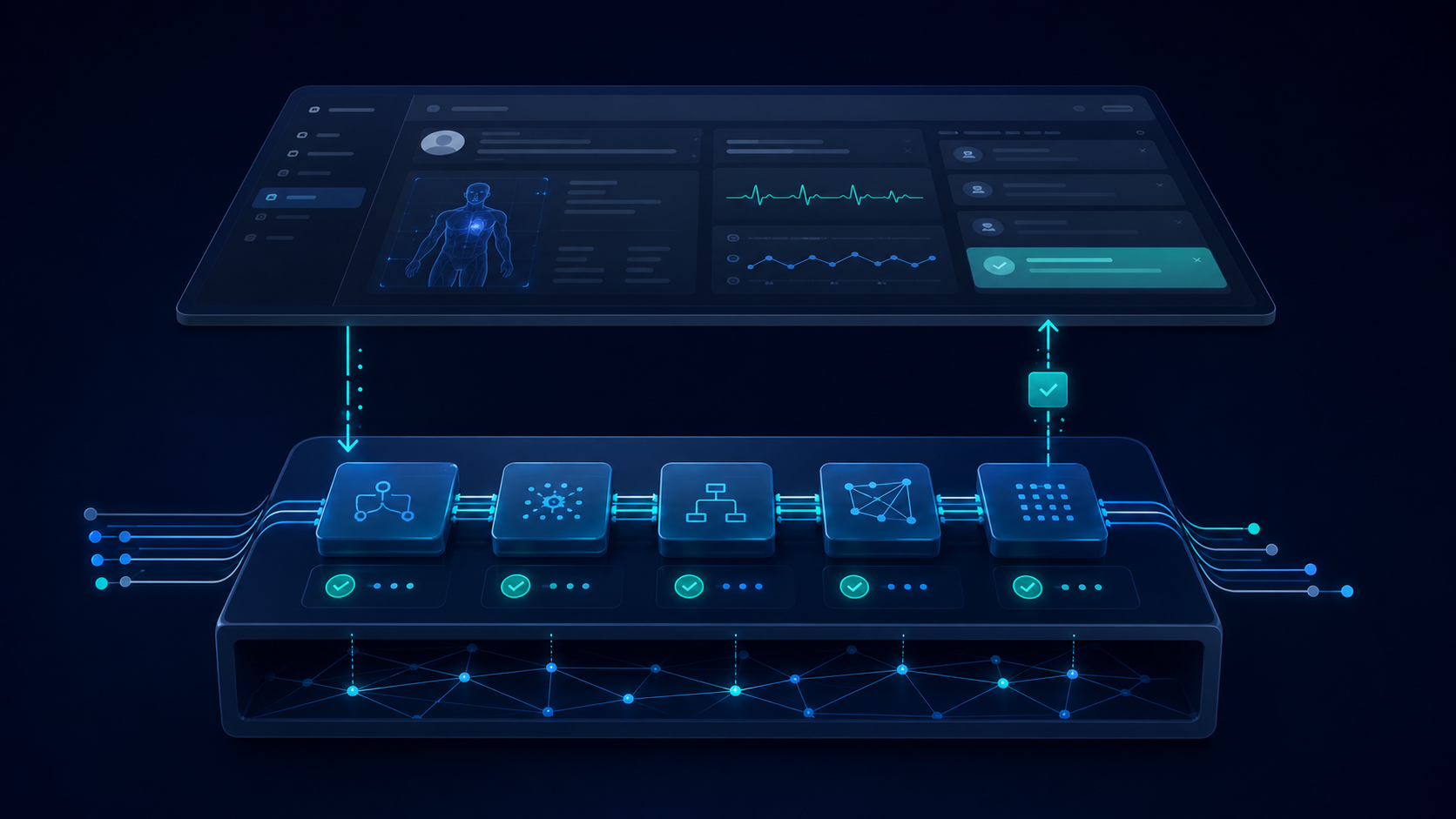
Build the Clinical Engine Before the Interface
A reliable clinical application separates guideline logic from presentation, tests expected behavior, and carries provenance into every recommendation.

Maternal-Fetal Medicine Specialist