Surviving the AI-Native Transformation: A Physician-Developer's Guide
AI makes clinical software cheap to produce. It does not make it safe. Physician-developers must build systems in which speed remains subordinate to evidence, judgment, and the doctor-patient relationship.
Listen to this post
Surviving the AI-Native Transformation: A Physician-Developer's Guide

On this page6 sections
I can generate a clinical software prototype in minutes.
I can draft decision-support logic, build an interface, and create structured documentation before a conventional project team finishes scheduling its first requirements meeting.
That sounds like pure advantage.
It is not.
When the marginal cost of production approaches zero, production stops being the scarce resource. Judgment becomes the scarce resource.
In software, undisciplined speed produces fifty half-tested features no one requested. In medicine, it produces a chatbot that gives confident, incorrect advice to a patient with gestational diabetes or a risk calculator that quietly departs from the guideline it claims to encode.
Volume is not the goal.
Correctness is.
I. Cheap Production Creates a New Clinical Risk
AI can produce plausible clinical text easily. That capability is no longer remarkable.
The difficult work is knowing whether the text is correct, whether the recommendation is safe, and whether the shortcut that saves thirty seconds today creates harm six months from now.
Medical ethics and domain expertise do not become less valuable in an AI-native workflow. They become the boundary between a fast tool and a dangerous one.
This is the medical-grade constraint: every gain in production speed must remain subordinate to evidence, clinical judgment, and an observable path to correction.
Without that constraint, speed scales error.
II. Automation Inherits Its Inputs
The rules that make AI-native companies fast only work as a system.
Removing meetings without rigorous documentation produces chaos. Removing roadmaps without placing product judgment close to the code produces drift. Automating an output while ignoring the inputs simply makes the failure arrive faster.
I see this in clinical documentation and billing.
CodeCraftMD depends on structured clinical documentation upstream. If the APSO note is incomplete, the automated coding workflow inherits the omission and can produce a confident, incorrect claim. Automation does not repair a broken input.
It scales it.
The reverse also matters. Meticulous documentation that sits in a folder no clinician, billing system, or agent can act on is well written but operationally inert.
A system only functions as a system. Half of it, done well, is still half a system.
III. Build for Two Readers
When I build a gestational-diabetes education tool or a preeclampsia risk calculator, I am no longer designing only for the person reading the screen.
I am designing for two readers.
The first is human: a patient, physician, nurse, or resident who needs the output to be clear at the point of care.
The second is computational: an EHR integration, monitoring service, or future agent that needs structured data, stable labels, and unambiguous outputs.
Both readers matter.
A page can be visually elegant and computationally useless. An API response can be perfectly structured and clinically unreadable. Medical-grade software has to serve the human encounter and the systems surrounding it.
Retrofitting either audience later is expensive.
IV. Teach the Build Forward
Speed that lives inside one person’s head does not scale. It also disappears when that person leaves.
AI-native clinical teams need documentation that transfers judgment, not only instructions. The important record is not merely what worked. It is why the boundary was placed there, what failed during testing, which assumptions remain provisional, and where a human checkpoint is required.
That is part of why Doctors Who Code exists.
Not to perform expertise. To distribute it.
Physician-developers should publish the pipelines, architecture decisions, and failure modes behind the finished interface. The screenshot shows the outcome. The build record teaches another clinician how to inspect it.
Expertise without distribution is incomplete.
V. Protect the Relationship on Purpose
Automating coordination is not the same as automating the relationship.
A patient with preeclampsia does not need a faster chatbot standing between her and her physician. She needs a physician with enough time and attention to explain why her blood pressure, laboratory results, fetal testing, and gestational age point toward a particular plan.
The coordination around that encounter can be compressed. The encounter itself should not be treated as overhead.
Every clinical automation should face a simple test: does this system return time and trust to the doctor-patient relationship, or does it quietly replace the relationship?
The first is architecture.
The second is abandonment disguised as efficiency.
VI. Speed Must Remain Governed
Part 1 addressed the structural problem: repeatable coordination should move out of meetings and into systems.
But structure without discipline is not enough.
The bridge between administrative overhead and medical-grade software is not more automation. It is automation designed and governed by people who understand the code and the clinic well enough to distinguish fast from reckless.
AI-native medicine will make building easier. It will make judgment more consequential.
Related articles

AI Just Outperformed Physicians at Clinical Writing. This Should Not Surprise You.
HealthBench Professional shows AI has already crossed the threshold in clinical writing and documentation. The real lesson is not replacement. It is that physician-developers need to build the harness.
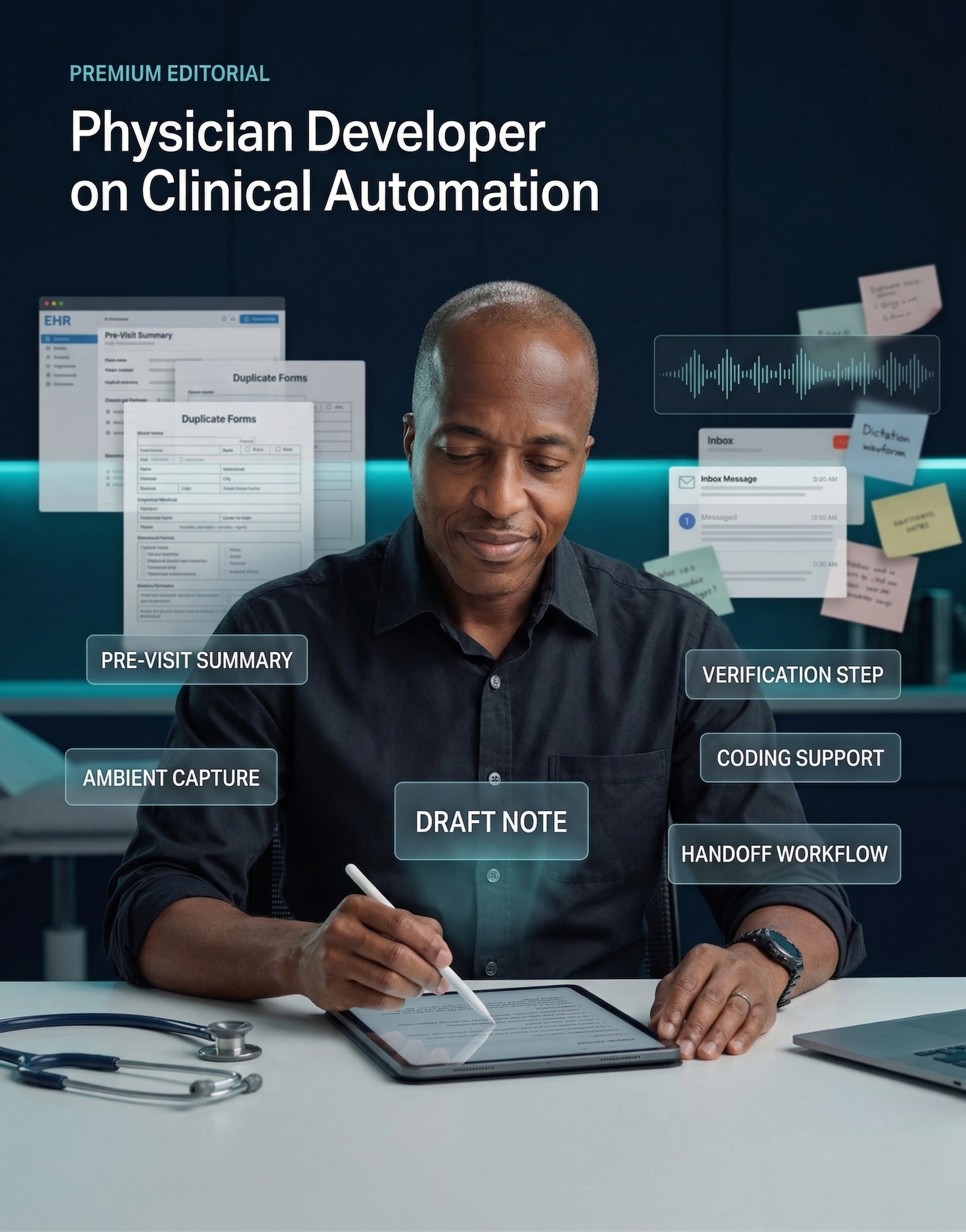
Clinical Documentation Automation Should Remove Friction, Not Replace the Doctor
Documentation automation is not a typing solution. It is a workflow design problem. For physicians and physician-developers, the real goal is protecting clinical judgment from administrative drag.
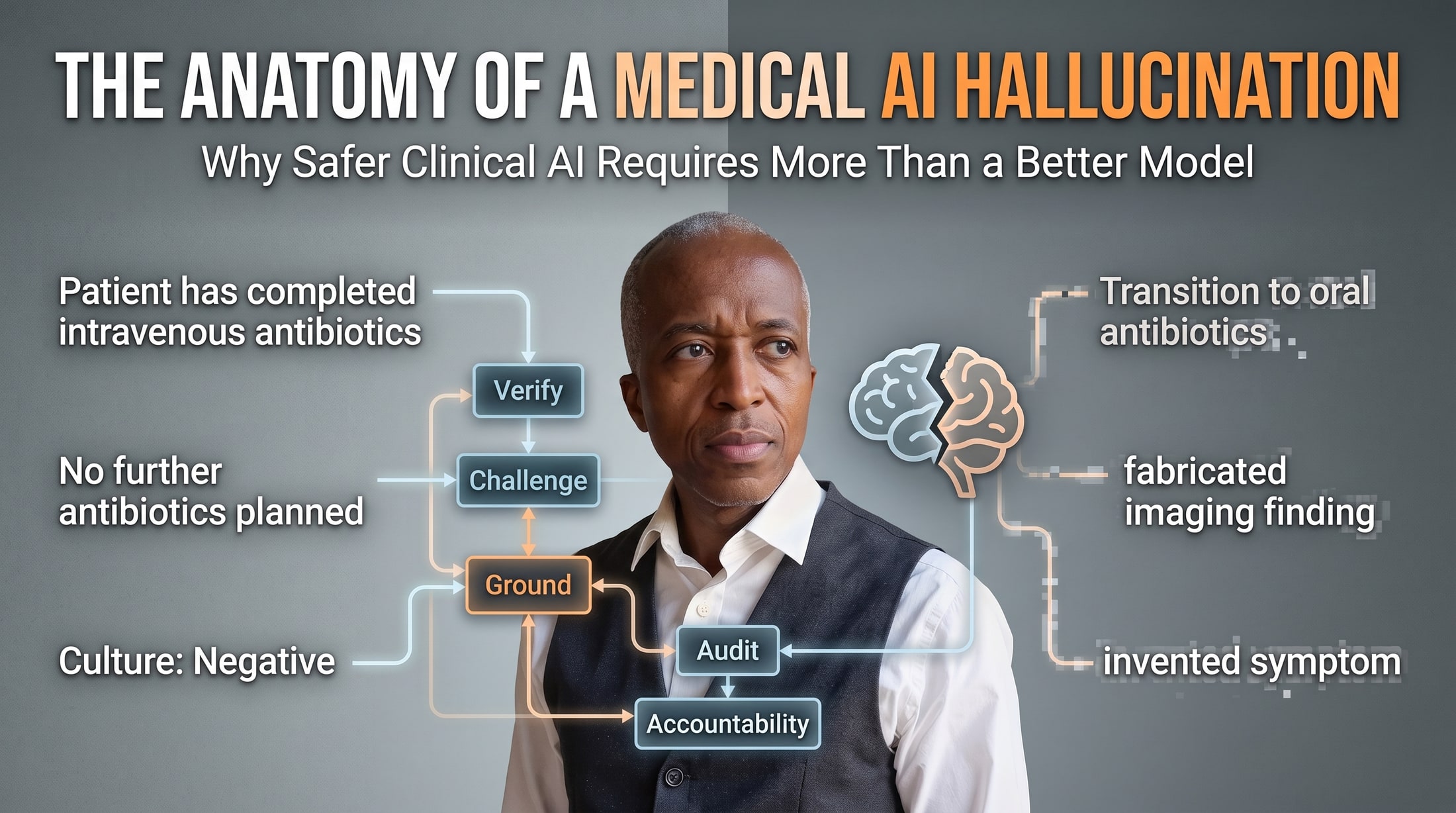
The Anatomy of a Medical AI Hallucination
Medical AI hallucinations become dangerous when plausible invention enters a clinical workflow. A physician-developer's guide to grounding, verification, harnesses, and human accountability.

Maternal-Fetal Medicine Specialist