Nurse Benjamin's Warning: Thirty Years of Clinical Documentation
From paper charts at Harlem Hospital in 1992 to ambient AI in 2026, the tools changed four times. The physician's responsibility toward the record did not.
In This Lesson
Read with a defined objective.
Learning objectives
- Trace clinical documentation through paper charts, early templates, human dictation, and the EMR.
- Identify which documentation habits are historical artifacts rather than present requirements.
- Explain what stayed constant across every documentation era.
Prerequisites
No prior lesson is required. Begin with the problem in front of you.
Use AI in Medicine Ambient Clinical Documentation
Listen to this post
Nurse Benjamin's Warning: Thirty Years of Clinical Documentation
On this page 5 sections
Course lessons 10 lessons
In this course
Ambient Clinical DocumentationNurse Benjamin used to joke that it was almost worse to lose the chart than to lose the patient.
That was gallows humor, common in hospitals, and I understood it as a joke at the time. I have thought about it seriously many times since. If the paper chart at Harlem Hospital disappeared and there was no copy, part of the patient’s medical history disappeared with it. The joke was funny because it was true.
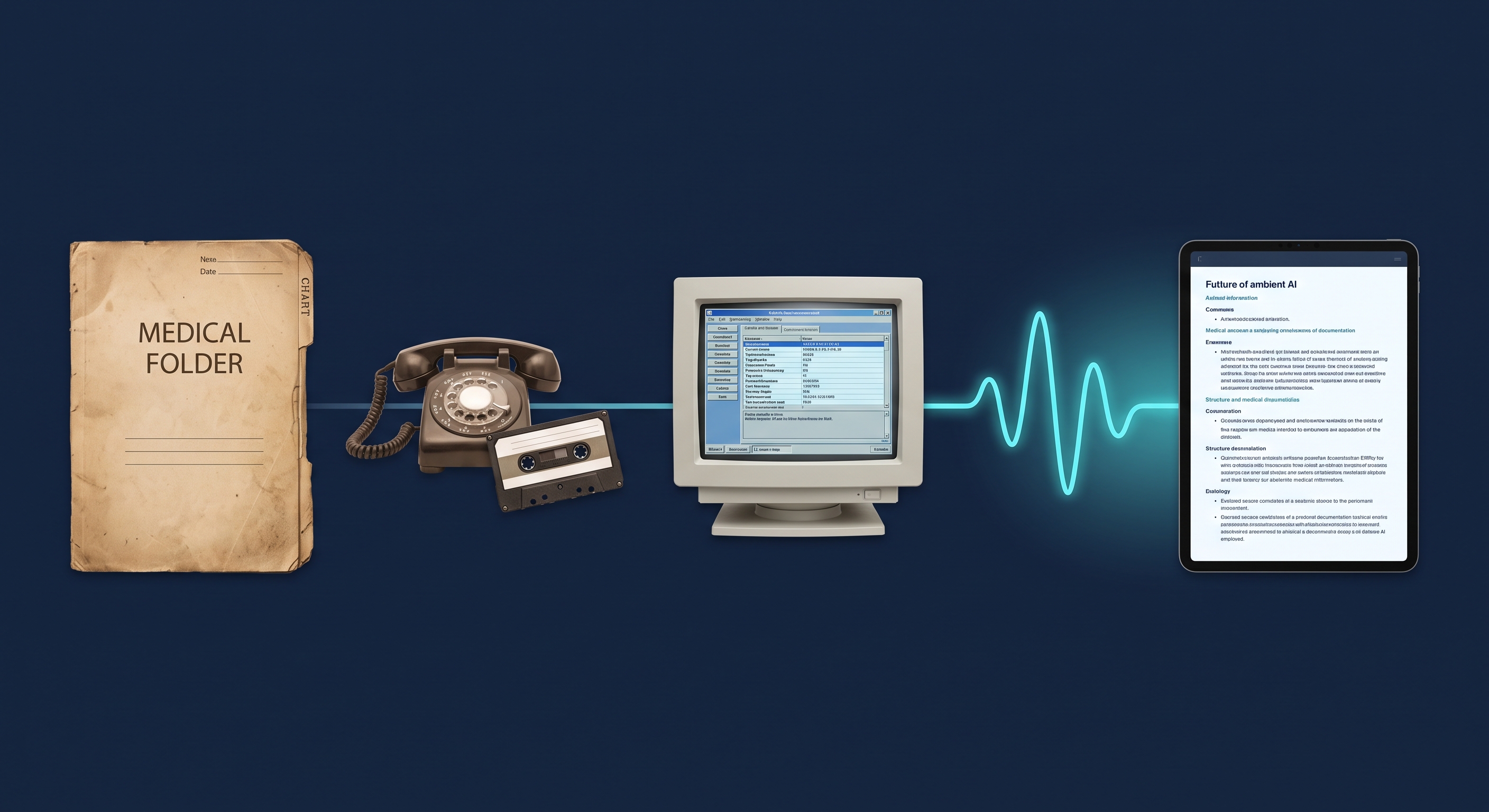
I have now practiced through four distinct eras of clinical documentation. Ambient AI is the fourth. It is worth walking through the other three, because the physician’s responsibility did not change with the technology, and every era tried to convince us otherwise.
I. 1992: The Chart Was Literally a Chart
When I became a physician in 1992, electronic medical records were not part of ordinary clinical practice. We wrote consultations and progress notes on paper and placed them into physical folders. Those folders moved through the hospital carried by runners, floor to floor, by hand.
The chart was a physical object with a physical location. It could be lost, misplaced, or sitting in the wrong bin on the wrong floor while a physician needed it immediately. Nurse Benjamin’s warning reflected a real operational risk, not just a dark joke. The record was only as durable as the paper it was written on.
II. 1994: An Early Attempt at Structure
By 1994, services like America Online were introducing physicians to a new digital world, and I began experimenting with ways to avoid rewriting the same material over and over. For common clinical situations, I created paper templates with the repetitive portions of a note already written, leaving blanks for the patient-specific details.
A colleague, Dr. Barbara Lanzera, saw one of these forms and objected. The expectation, she said, was that a note should be written individually for each patient.
She was not wrong about the norm. I was not wrong about the problem. The photocopied form itself was not the important idea. The important idea, which took me years to state clearly, was that much of clinical documentation is repetitive and structured, and treating every note as a blank page wastes attention that the patient-specific parts actually need.
III. 2003: The Human Dictation Era
When I came to Atlanta in 2003, dictation services felt remarkably advanced. I could call a telephone number, dictate a consultation or an operative report, and a human transcriptionist would listen to the recording and produce a typed document.
The modern ambient scribe has a direct ancestor in that workflow. A clinician spoke. A trained listener turned speech into a structured document. The only thing that changed between 2003 and now is who, or what, is doing the listening.
IV. The EMR Promise, and Its Paradox
Electronic medical records arrived with real advantages: legibility, organization, searchability, and a record that did not depend on a single physical folder surviving the day. Nurse Benjamin’s specific fear, the lost chart, became far less likely.
But EMRs introduced a new cost. Clicks, menus, dropdowns, required fields, and templates that multiplied instead of simplifying. Creating the record could itself become a substantial part of the clinical work, sometimes the dominant part. The paradox was that the tool built to protect the chart made writing the chart harder.
The Ambient Era
Large language models changed the equation again. A system can now capture natural conversation, distinguish clinically relevant material from small talk, organize it, and produce a structured draft without a human transcriptionist and without a clinician typing during the encounter.
This is not the end of the story. It is the fourth chapter of a much older one: physicians have always searched for a way to preserve an accurate record without letting the act of recording it overwhelm the reason the record exists in the first place.
Which era shaped your own documentation habits? More importantly, which of those habits are you still carrying that the current tools no longer require?
Related articles

The One-Week Ambient Challenge
A seven-day self-audit for physicians using an approved ambient documentation system, built around three questions that matter more than words per minute.
Build an Ambient Documentation Lab Before You Buy One
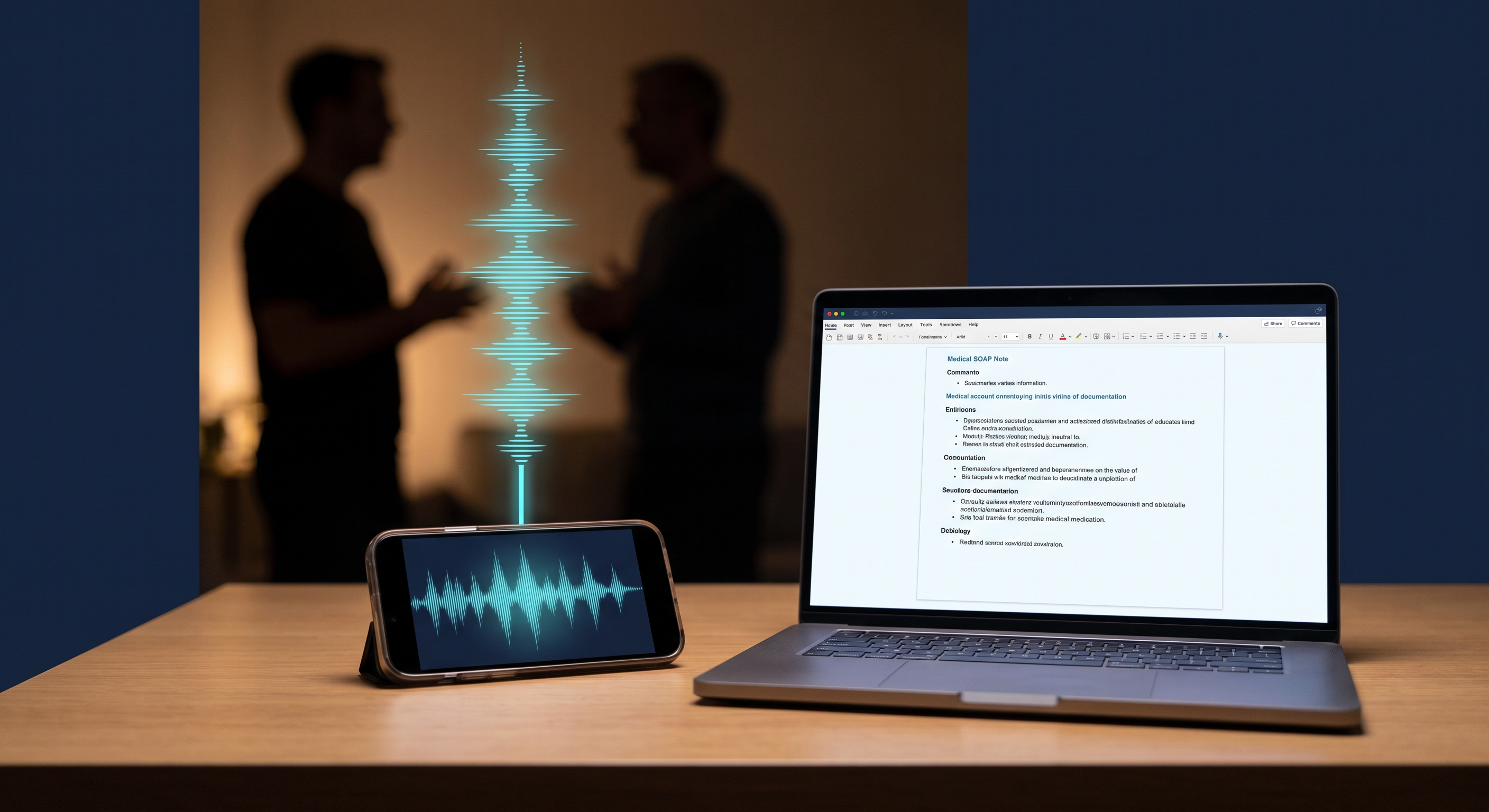
You can learn the entire ambient documentation pipeline with a phone, a fictional patient, and a general-purpose AI assistant, before spending a dollar on a clinical platform.
Your First Ambient Note Is Not Your Final Workflow
Most physicians stop optimizing an ambient documentation system the moment it produces a usable note. That is the moment the real work should start.

Maternal-Fetal Medicine Specialist